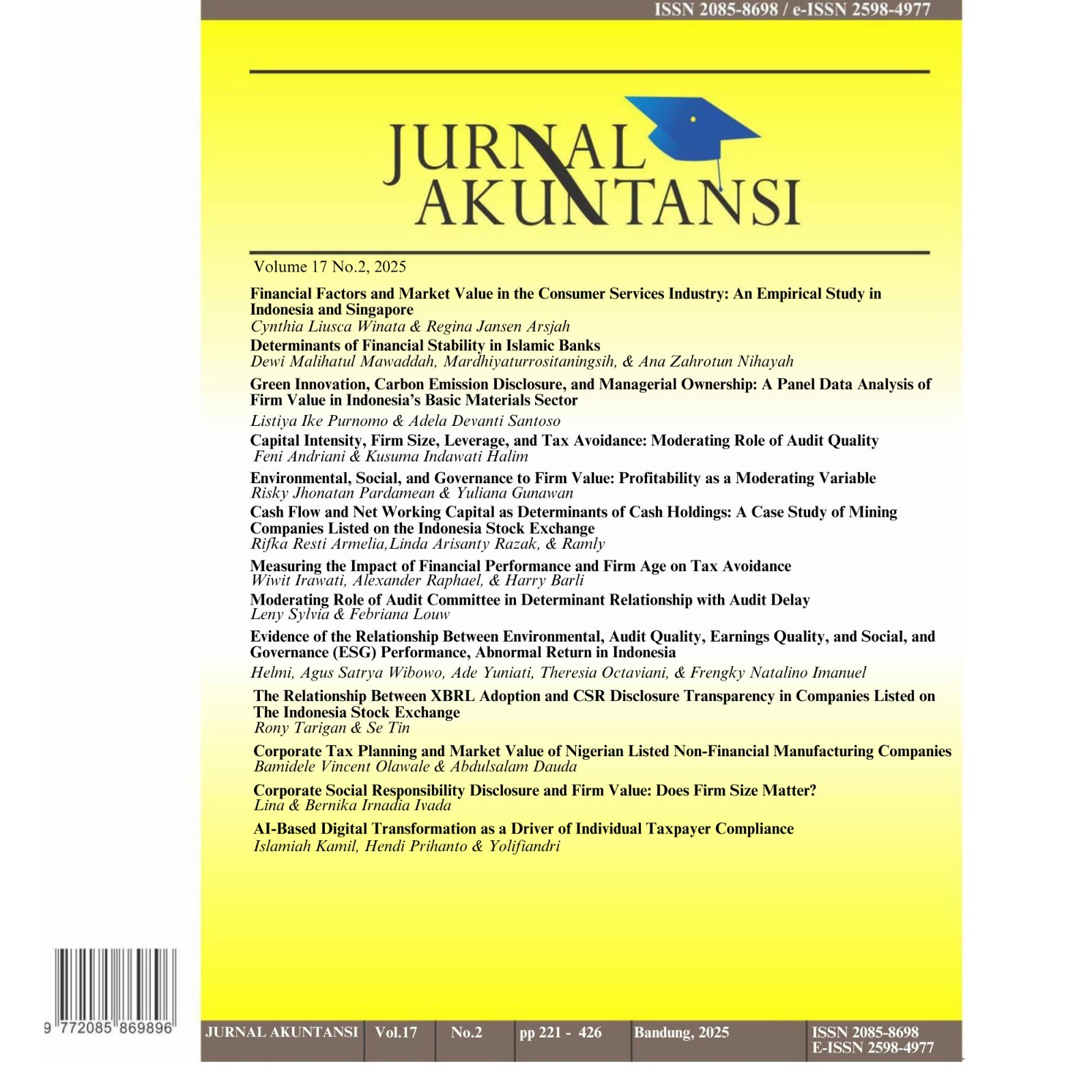
Determinants of Financial Stability in Islamic Banks
Article Sidebar
Published:
Oct 13, 2025
Main Article Content
Abstract
Purpose – This study aims to analyze the factors that influence inflation, financing risk, and digital payments on financial stability at Islamic Commercial Banks in Indonesia. Design/Methodology/Approach – This study uses a quantitative approach and purposive sampling technique with sample criteria being banks listed during the study period and publishing complete quarterly reports consistently. The data analysis technique uses panel data regression analysis, with the Random Effect Model (REM) in EViews 13. Findings – The results of the study indicate that inflation has a significant positive effect on the financial stability of Islamic banks. Financing risk has a significant negative effect on the financial stability of Islamic banks. Meanwhile, the digital payment variable does not have a significant effect on the financial stability of Islamic banks.Research limitations/Implications – This study provides empirical insights by combining macroeconomic, risk, and digital payment variables to assess the stability of Islamic banks, which has been underexplored in previous research. The limitation of this study is the limited variable and geographical coverage of Islamic banks in Indonesia. Therefore, future research is recommended to include other factors and use a cross-country comparative approach to gain a more complex understanding of the financial resilience of Islamic banks.
Keywords: Digital Payments, Financial Stability, Financing Risk, and Inflation
Keywords: Digital Payments, Financial Stability, Financing Risk, and Inflation
Downloads
Download data is not yet available.
Article Details
How to Cite
Mawaddah, D. M. ., Mardhiyaturrositaningsih, M., & Nihayah, A. Z. (2025). Determinants of Financial Stability in Islamic Banks. Jurnal Akuntansi, 17(2), 239–252. https://doi.org/10.28932/jam.v17i2.11866
Section
Articles

This work is licensed under a Creative Commons Attribution-NonCommercial 4.0 International License.