Digital Accounting Tools and Perceived Financial Reporting Accuracy in Sri Lankan Universities
Article Sidebar
Published:
May 21, 2026
Main Article Content
Abstract
Purpose – This study examines the impact of digital accounting tools on perceived financial reporting accuracy among accounting staff in Sri Lankan universities, focusing on the extent of use, system quality, and user competency.
Design/Methodology/Approach – A quantitative cross-sectional survey was conducted with 200 accounting staff from public and private universities. Data were collected via a structured questionnaire using five-point likert scales. Reliability was tested using cronbach’s alpha, and relationships were analyzed with Pearson correlation and multiple regression.
Results – All three variables significantly and positively influence perceived financial reporting accuracy. Extent of use and user competency had the strongest effects, followed by system quality. The model explains 93.5% of the variance in perceived accuracy.
Research limitations/Implications – The study focuses on perceived rather than objective accuracy and is limited to Sri Lankan universities. Findings offer practical guidance for improving digital accounting practices and financial governance in higher education.
Keywords: Digital Accounting Tools, Perceived Financial Reporting Accuracy, Sri Lankan Universities, System Quality, User Competency
Design/Methodology/Approach – A quantitative cross-sectional survey was conducted with 200 accounting staff from public and private universities. Data were collected via a structured questionnaire using five-point likert scales. Reliability was tested using cronbach’s alpha, and relationships were analyzed with Pearson correlation and multiple regression.
Results – All three variables significantly and positively influence perceived financial reporting accuracy. Extent of use and user competency had the strongest effects, followed by system quality. The model explains 93.5% of the variance in perceived accuracy.
Research limitations/Implications – The study focuses on perceived rather than objective accuracy and is limited to Sri Lankan universities. Findings offer practical guidance for improving digital accounting practices and financial governance in higher education.
Keywords: Digital Accounting Tools, Perceived Financial Reporting Accuracy, Sri Lankan Universities, System Quality, User Competency
Downloads
Download data is not yet available.
Article Details
How to Cite
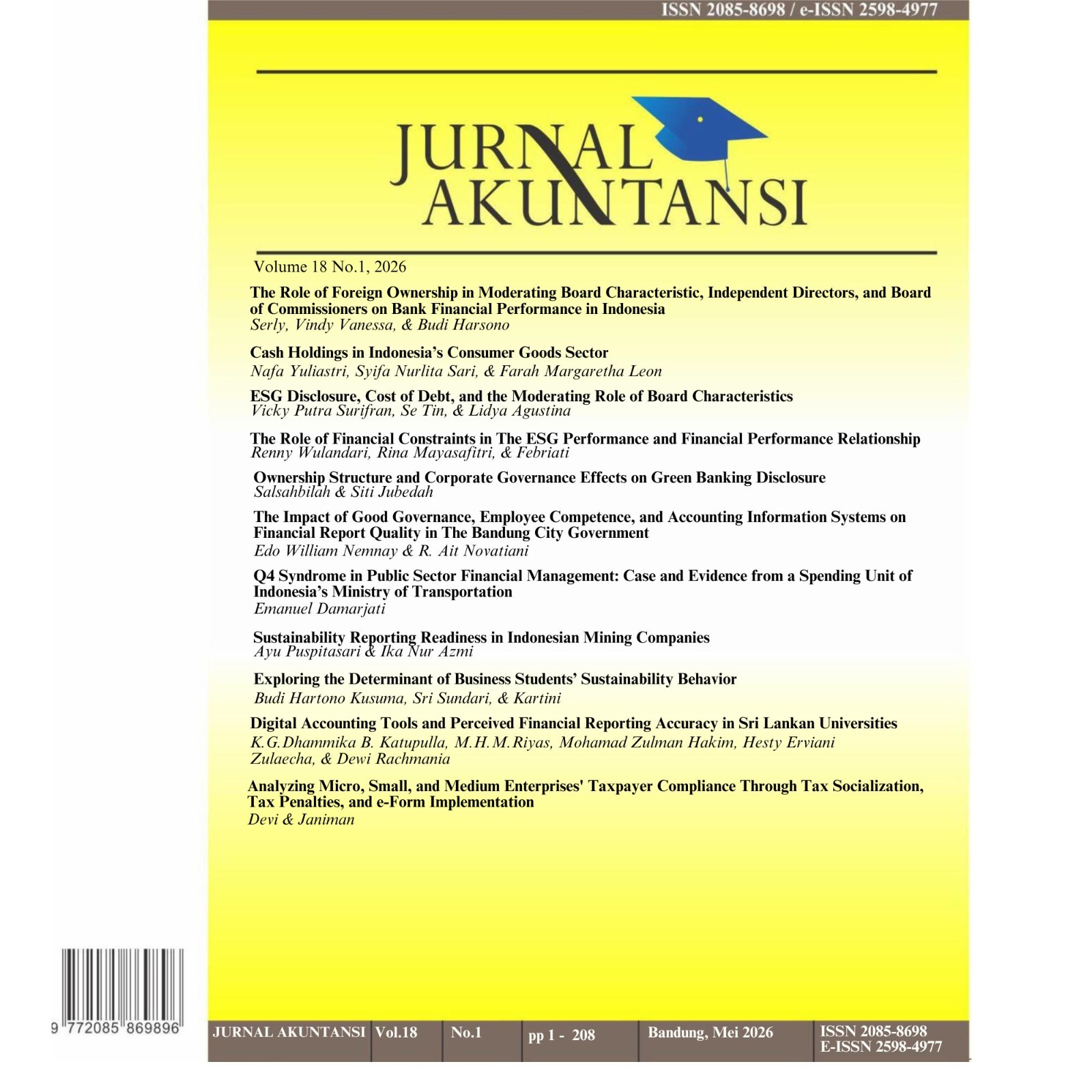
Katupulla, K. B. ., Riyas, M., Hakim, M. Z. ., Zulaecha, H. E. ., & Rachmania, D. . (2026). Digital Accounting Tools and Perceived Financial Reporting Accuracy in Sri Lankan Universities. Jurnal Akuntansi, 18(1), 177–193. https://doi.org/10.28932/jam.v18i1.13617
Section
Articles

This work is licensed under a Creative Commons Attribution-NonCommercial 4.0 International License.