Using Team Roles Orientation to Improve Accounting Project-Based Learning Outcomes
Article Sidebar
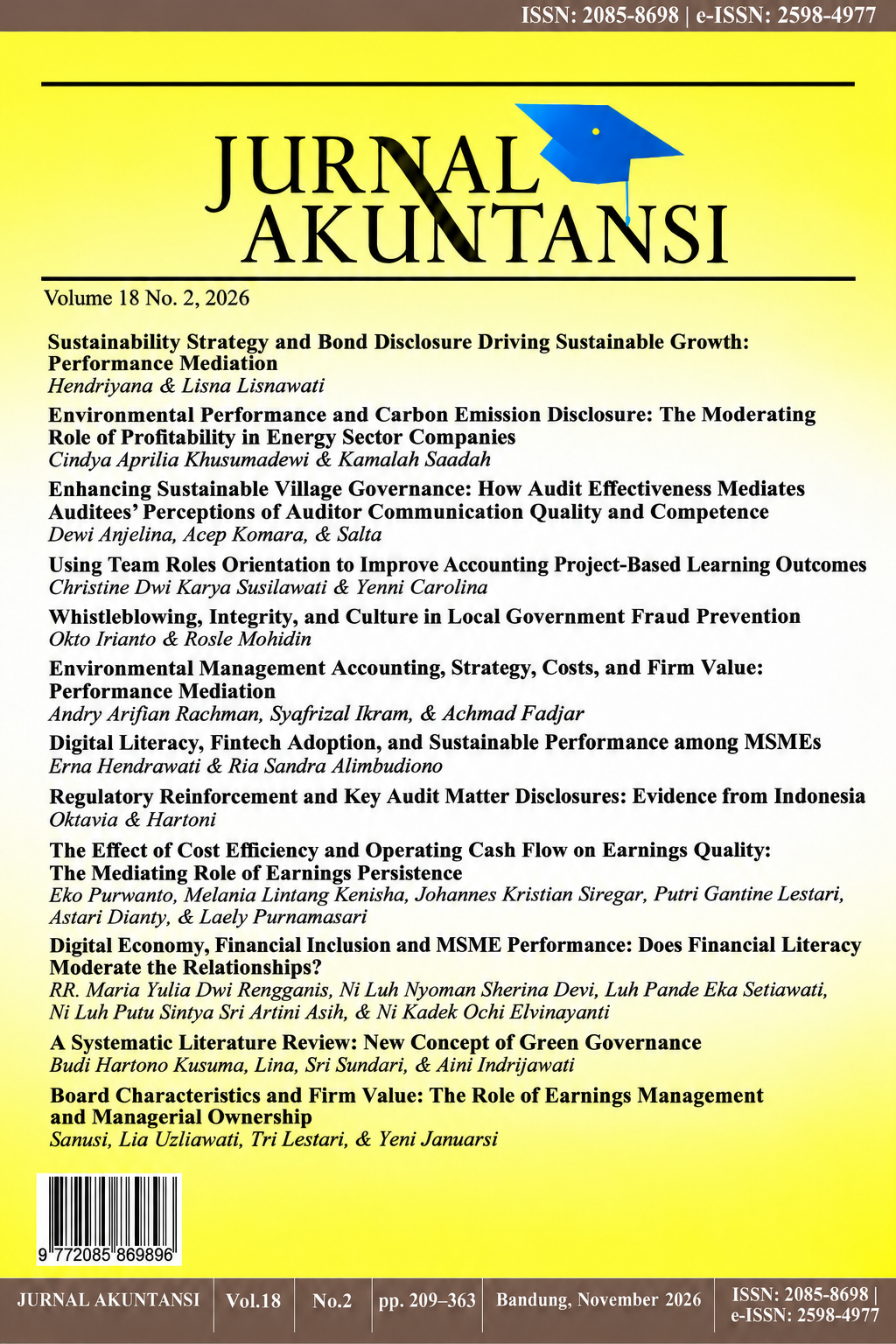
Published:
Nov 13, 2026
Main Article Content
Abstract
Purpose – Previous studies have shown inconsistent findings on how team roles influence students’ learning outcomes. This study uses Belbin’s Team Roles Theory to examine how team role orientations relate to students’ performance in Project-Based Learning (PBL) in Accounting Information Systems education.
Design/Methodology/Approach – A quantitative approach was applied to 34 students enrolled in an Accounting Information Systems course. Students’ dominant team role orientations were identified through a questionnaire. Multiple regression analysis using SPSS was then conducted to examine the relationship between People-, Thinking-, and Action-oriented roles and project-based learning outcomes.
Results – The findings show that Thinking- and Action-oriented roles were significantly related to project outcomes, while the People-oriented role was not significant. When the three orientations were considered simultaneously, their relationship with project and case scores was also not statistically significant. The model explained 16% of the variation in project outcomes.
Originality – This study extends the application of Belbin’s Team Roles Theory to accounting education by examining team role orientations in PBL. The findings indicate that cognitive and task-oriented roles may be particularly relevant to students’ project performance.
Research limitations/Implications – The study is limited to 34 students from one Accounting Information Systems course. Future research should involve larger and more diverse samples across accounting courses and learning contexts to provide a broader understanding of how team roles support collaborative learning.
Keywords: Accounting Education, Belbin, Team Roles, Project-Based Learning
Downloads
Download data is not yet available.
Article Details
How to Cite
Susilawati, C. D., & Carolina, Y. . (2026). Using Team Roles Orientation to Improve Accounting Project-Based Learning Outcomes. Jurnal Akuntansi, 18(2), 245–256. https://doi.org/10.28932/jam.v18i2.15508
Section
Articles

This work is licensed under a Creative Commons Attribution-NonCommercial 4.0 International License.