Enhancing Sustainable Village Governance: How Audit Effectiveness Mediates Auditees' Perceptions of Auditor Communication Quality and Competence
Article Sidebar
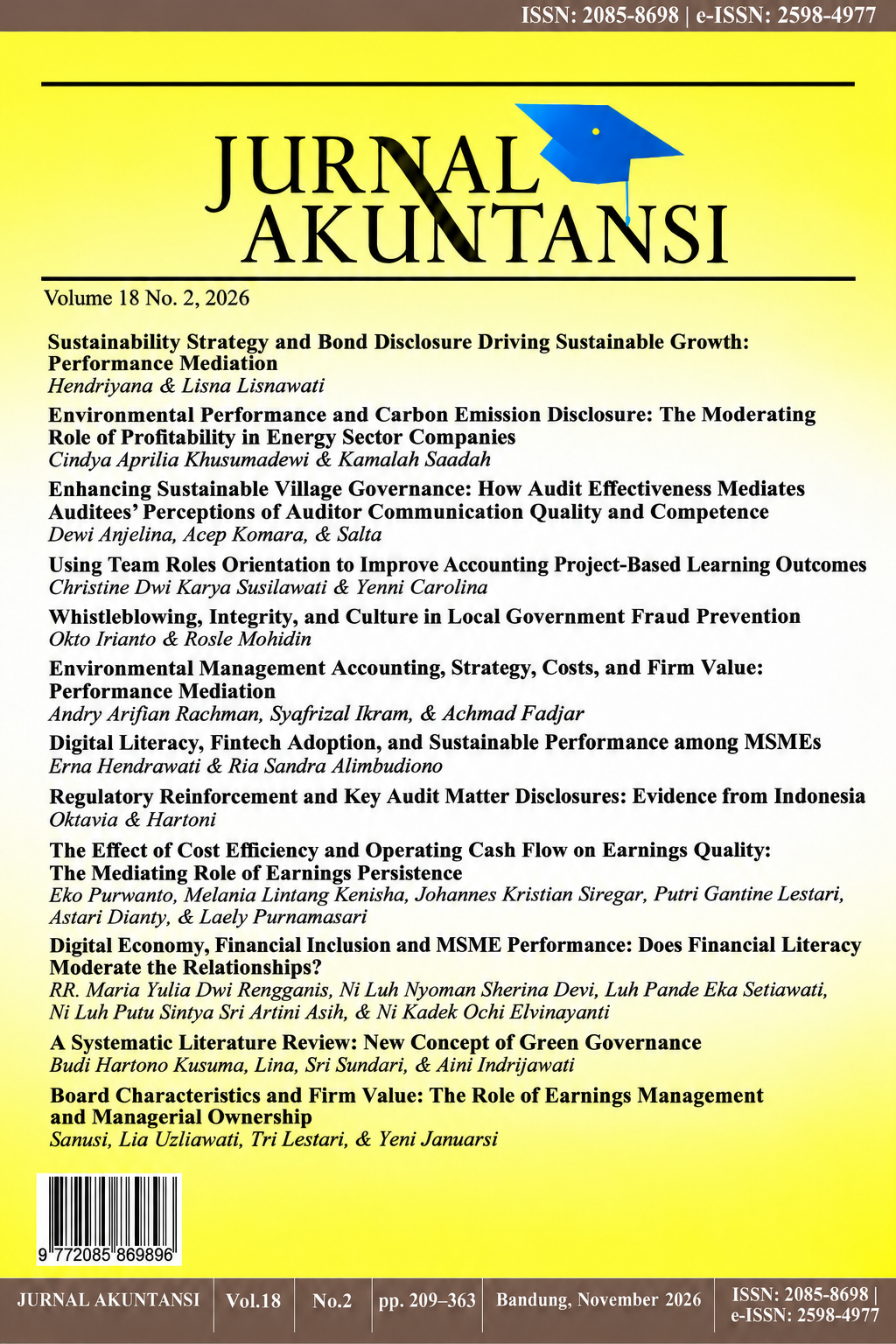
Published:
Nov 13, 2026
Main Article Content
Abstract
Purpose – This study aims to examine the influence of auditees' perceptions of auditor communication quality, competence, and integrity on audit effectiveness, and to analyze the mediating role of audit effectiveness in achieving sustainable village governance.
Design/Methodology/Approach – A quantitative associative approach employing Partial Least Squares Structural Equation Modeling (PLS-SEM) via SmartPLS 4.1.1.2 was adopted. Data were collected via a census method from village and sub-district officials across five districts in Cirebon Regency, yielding 95 valid responses from 120 distributed questionnaires.
Results – Findings reveal that auditees' perceptions of auditor communication quality, competence, and integrity significantly enhance audit effectiveness, explaining 67.8% of its variance. However, these perceptions do not directly influence sustainable governance; the relationship is fully mediated by audit effectiveness, with the overall model explaining 55.9% of the variance in governance outcomes.
Originality – This study contributes original insight by examining audit effectiveness within the underexplored context of village governance, where empirical evidence remains limited relative to ministerial or large-organization settings, and by applying the Theory of Planned Behavior to explain the auditor-auditee behavioral mechanism underlying sustainable governance.
Research limitations/Implications – This study is limited to village officials in Cirebon Regency, constraining generalizability, and does not account for contextual factors such as organizational culture and local leadership dynamics. Findings imply that strengthening auditor competence and audit processes that generate tangible follow-up recommendations are essential for regional Inspectorates seeking to sustain accountable village governance.
Keywords: Audit Effectiveness, Auditee’s Perception, Sustainability, Village Governance
Downloads
Download data is not yet available.
Article Details
How to Cite
Anjelina, D., Komara, A. ., & Salta, S. (2026). Enhancing Sustainable Village Governance: How Audit Effectiveness Mediates Auditees’ Perceptions of Auditor Communication Quality and Competence . Jurnal Akuntansi, 18(2), 233–244. https://doi.org/10.28932/jam.v18i2.15740
Section
Articles

This work is licensed under a Creative Commons Attribution-NonCommercial 4.0 International License.