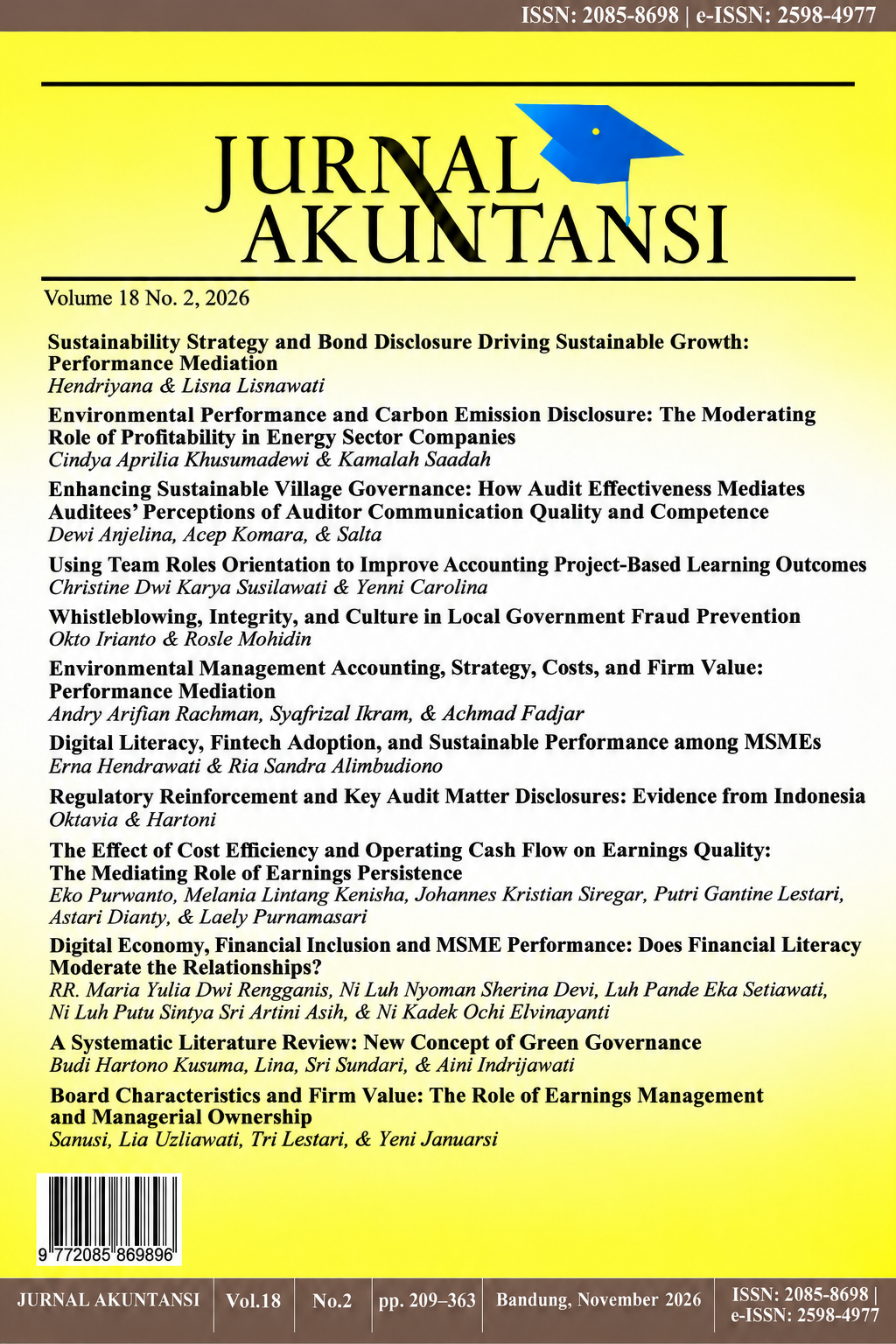
Whistleblowing, Integrity, and Culture in Local Government Fraud Prevention
Article Sidebar
Published:
Nov 13, 2026
Main Article Content
Abstract
Purpose – This study examines the effects of whistleblowing systems and employee integrity on fraud prevention in local government institutions, and tests whether organizational culture moderates these relationships, addressing a gap in research that has rarely examined systemic and individual fraud prevention mechanisms jointly.
Design/Methodology/Approach – Using Partial Least Squares Structural Equation Modeling (PLS-SEM), primary data were collected through a structured questionnaire administered to 214 civil servants across 29 Regional Apparatus Organizations (OPD) in Merauke Regency, Indonesia, selected through purposive proportional sampling.
Results – Whistleblowing systems (β = 0.312, p < 0.001) and employee integrity (β = 0.374, p < 0.001) both significantly enhance fraud prevention, jointly explaining 47.8% of its variance. Organizational culture significantly strengthens the relationship between whistleblowing–fraud prevention (β = 0.143, p = 0.027), but does not significantly moderate the relationship between employee integrity and fraud prevention (β = 0.089, p = 0.141).
Originality – This study extends the Fraud Diamond framework by testing organizational culture as a moderator of both systemic (whistleblowing) and individual (integrity) fraud prevention mechanisms simultaneously, a combination rarely examined together in local government settings, particularly in Indonesia’s eastern regions such as Merauke Regency.
Research limitations/Implications – The cross-sectional, single-regency sample limits the generalizability of the findings. The results suggest that formal reporting mechanisms are more context-dependent on organizational culture than individual moral commitment, so local governments should combine systemic, individual, and cultural interventions to strengthen fraud prevention efforts.
Keywords: Employee Integrity, Fraud Prevention, Local Government, Organizational Culture, Whistleblowing Systems
Design/Methodology/Approach – Using Partial Least Squares Structural Equation Modeling (PLS-SEM), primary data were collected through a structured questionnaire administered to 214 civil servants across 29 Regional Apparatus Organizations (OPD) in Merauke Regency, Indonesia, selected through purposive proportional sampling.
Results – Whistleblowing systems (β = 0.312, p < 0.001) and employee integrity (β = 0.374, p < 0.001) both significantly enhance fraud prevention, jointly explaining 47.8% of its variance. Organizational culture significantly strengthens the relationship between whistleblowing–fraud prevention (β = 0.143, p = 0.027), but does not significantly moderate the relationship between employee integrity and fraud prevention (β = 0.089, p = 0.141).
Originality – This study extends the Fraud Diamond framework by testing organizational culture as a moderator of both systemic (whistleblowing) and individual (integrity) fraud prevention mechanisms simultaneously, a combination rarely examined together in local government settings, particularly in Indonesia’s eastern regions such as Merauke Regency.
Research limitations/Implications – The cross-sectional, single-regency sample limits the generalizability of the findings. The results suggest that formal reporting mechanisms are more context-dependent on organizational culture than individual moral commitment, so local governments should combine systemic, individual, and cultural interventions to strengthen fraud prevention efforts.
Keywords: Employee Integrity, Fraud Prevention, Local Government, Organizational Culture, Whistleblowing Systems
Downloads
Download data is not yet available.
Article Details
How to Cite
Irianto, O. ., & Mohidin, R. . (2026). Whistleblowing, Integrity, and Culture in Local Government Fraud Prevention. Jurnal Akuntansi, 18(2), 257–267. https://doi.org/10.28932/jam.v18i2.17168
Section
Articles

This work is licensed under a Creative Commons Attribution-NonCommercial 4.0 International License.