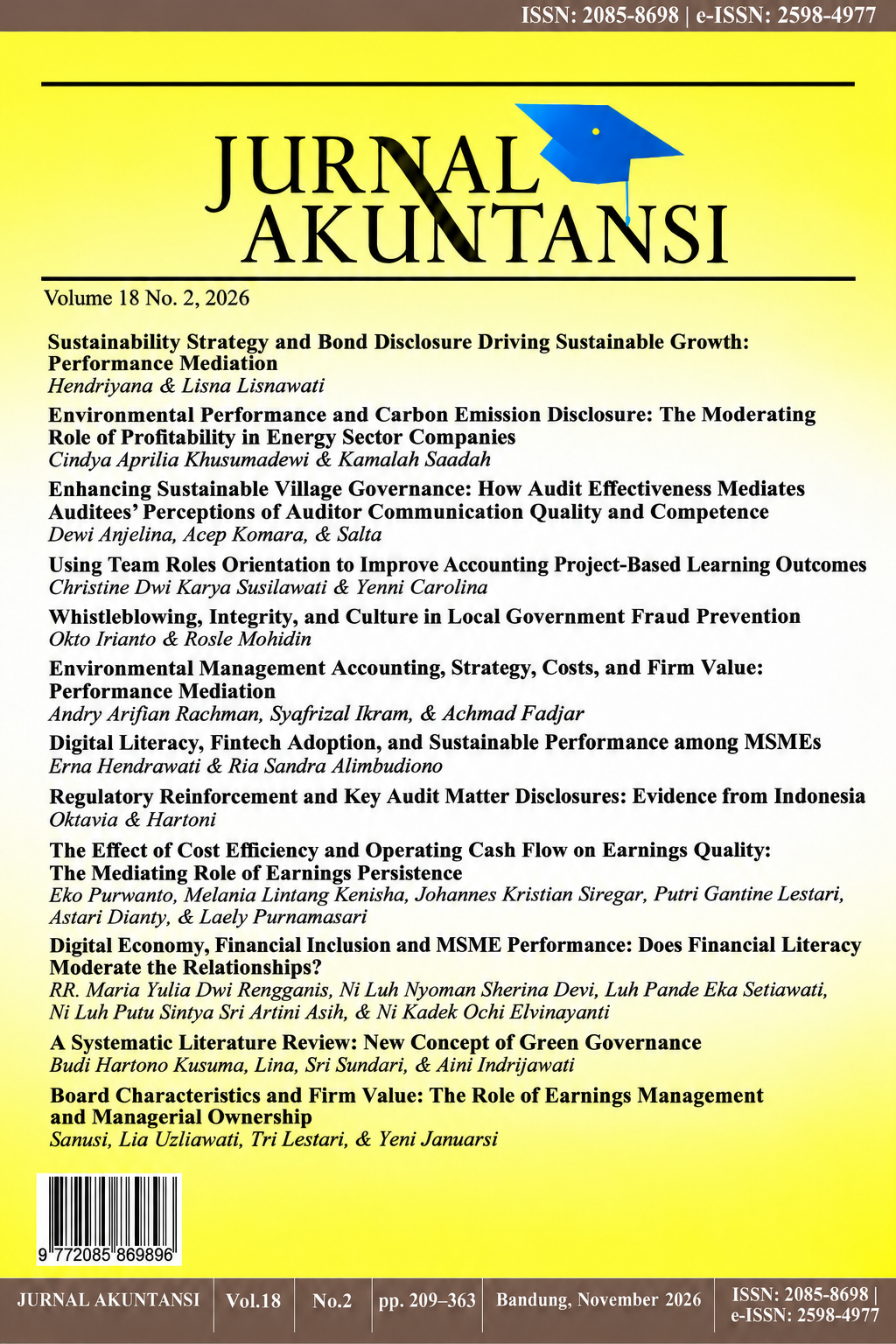
Digital Literacy, Fintech Adoption, and Sustainable Performance among MSMEs
Article Sidebar
Published:
Nov 13, 2026
Main Article Content
Abstract
Purpose – This study examines how digital literacy enables fintech adoption and how fintech adoption relates to environmental and economic sustainability performance through circular economy practices and green innovation among MSMEs in Surabaya, Indonesia.
Design/Methodology/Approach – A cross-sectional survey of 150 fintech-using MSME owner-managers was analyzed using PLS-SEM with bootstrapping and PLSpredict.
Results – Digital literacy is positively associated with fintech adoption. Fintech adoption is associated with circular economy practices, green innovation, and economic sustainability, but not directly with environmental sustainability. Its environmental association operates only through circular economy practices, whereas green innovation transmits its economic association.
Originality – The study explains how a digital capability is translated into sustainable performance, showing that the environmental value of fintech is contingent on operational circular routines.
Research limitations/Implications – The cross-sectional, single-city, self-reported design limits causal inference. MSME digitalization programs should couple fintech access with circular operating capabilities.
Keywords: Circular Economy, Digital Literacy, Fintech Adoption, Green Innovation, MSMEs Sustainable Performance
Downloads
Download data is not yet available.
Article Details
How to Cite
Hendrawati, E., & Alimbudiono, R. S. . (2026). Digital Literacy, Fintech Adoption, and Sustainable Performance among MSMEs. Jurnal Akuntansi, 18(2), 280–294. https://doi.org/10.28932/jam.v18i2.17425
Section
Articles

This work is licensed under a Creative Commons Attribution-NonCommercial 4.0 International License.