
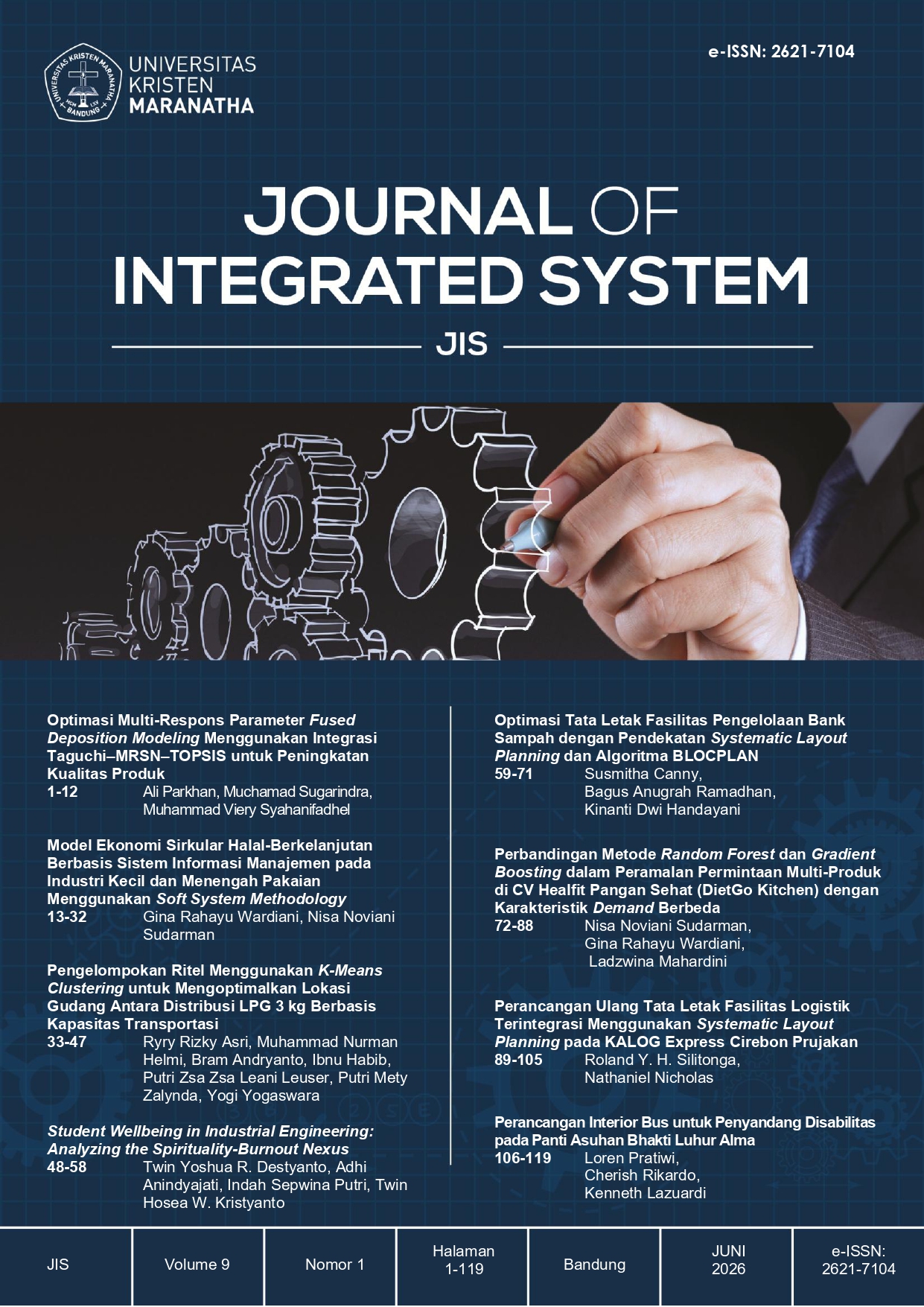
Bus Interior Design for the Disabled at Bhakti Luhur Alma Orphanage
Article Sidebar
Main Article Content
Abstract
Downloads
Article Details

This work is licensed under a Creative Commons Attribution-NonCommercial 4.0 International License.
By submitting an article with the title above and acceptance publication of the article, I declare that:
- Articles have never been previously published in scientific journals, proceedings or other electronic journals.
- I agree that the article copyright is fully owned by the Journal of Integrated System, Universitas Kristen Maranatha. Declaration of copyright transfer from the author's to the journal is done by completing the following form (Copyright Transfer Agreement).
Journal of Integrated System (JIS) uses a Copyright policy under a Creative Commons Attribution-NonCommercial 4.0 International (CC BY-NC 4.0) license.
References
Antropometri Indonesia (n.d.) Pengukuran antropometri. Available at: https://www.antropometriindonesia.org/index.php/detail/sub/3/4/0/dimensi_antropometri (Accessed: 2 April 2024).
Arianto, D. and Apsari, N.C. (2023) ‘Gambaran aksesbilitas, inklusivitas, dan hambatan penyandang disabilitas dalam memanfaatkan transportasi publik: studi literatur di berbagai negara’, Focus: Jurnal Pekerjaan Sosial, 5(2), p.156. Available at: https://doi.org/10.24198/focus.v5i2.42633.
Bustomi, M.I. and Sari, N. (2024) ‘Bus sekolah khusus penyandang disabilitas dilengkapi lantai pemandu tunanetra dan penangkut kursi roda’. Available at: https://megapolitan.kompas.com/read/2024/01/17/15553871/bus-sekolah-khusus-penyandang-disabilitas-dilengkapi-lantai-pemandu (Accessed: 2 April 2024).
Grots, A. and Creuznacher, I. (2016) ‘Design thinking: process or culture?’, in Design thinking for innovation. Cham: Springer International Publishing, pp.183–191. Available at: https://doi.org/10.1007/978-3-319-26100-3_13.
Hasanah, H. (2017) ‘Teknik-teknik observasi (sebuah alternatif metode pengumpulan data kualitatif ilmu-ilmu sosial)’, At-Taqaddum, 8(1), p.21. Available at: https://doi.org/10.21580/at.v8i1.1163.
Imrie, R. and Hall, P. (2001) Inclusive design: designing and developing accessible environments. London: Spon Press Taylor & Francis. Available at: https://doi.org/10.4324/9780203362501.
Kendrick, A. (2022) Inclusive design. Available at: https://www.nngroup.com/articles/inclusive-design/ (Accessed: 4 January 2023).
Lättman, K., Friman, M. and Olsson, L.E. (2016) ‘Perceived accessibility of public transport as a potential indicator of social inclusion’, Social Inclusion, 4(3), pp.36–45. Available at: https://doi.org/10.17645/si.v4i3.481.
Lewrick, M., Link, P. and Leifer, L.J. (2020) The design thinking toolbox: a guide to mastering the most popular and valuable innovation methods. Hoboken, New Jersey: Wiley & Sons, Inc.
Sianipar, J.A., Astuti, P. and Turtiantoro (2022) ‘Analisis kebijakan pemerintah daerah dalam pemenuhan aksesibilitas penyandang disabilitas terhadap layanan moda transportasi di DKI Jakarta’, Journal of Politic and Government Studies, 11(2), pp.503–520. Available at: https://ejournal3.undip.ac.id/index.php/jpgs/article/view/33630/0 (Accessed: 10 May 2024).
Stjernborg, V. (2019) ‘Accessibility for all in public transport and the overlooked (social) dimension: a case study of Stockholm’, Sustainability (Switzerland), 11(18). Available at: https://doi.org/10.3390/su11184902.
Sudarwati, E. (2016) ‘Kebijakan penanganan penyandang disabilitas personel Kemhan dan TNI’. Available at: https://www.kemhan.go.id/pusrehab/2016/11/24/artikel-kebijakan-penyandang-disabilitas.html (Accessed: 11 April 2024).
Sugiyono (2022) Metode penelitian: kuantitatif, kualitatif, dan R&D. Cetakan ke-27. Bandung: Alfabeta.
Supanji, T.H. (2023) ‘Pemerintah penuhi hak penyandang disabilitas di Indonesia’. Available at: https://www.kemenkopmk.go.id/pemerintah-penuhi-hak-penyandang-disabilitas-di-indonesia (Accessed: 10 February 2024).
Ulrich, K.T. and Eppinger, S.D. (2016) Product design and development. McGraw-Hill Education.
World Health Organization (2011) World report on disability. Available at: https://www.who.int/teams/noncommunicable-diseases/sensory-functions-disability-and-rehabilitation/world-report-on-disability (Accessed: 15 February 2024).