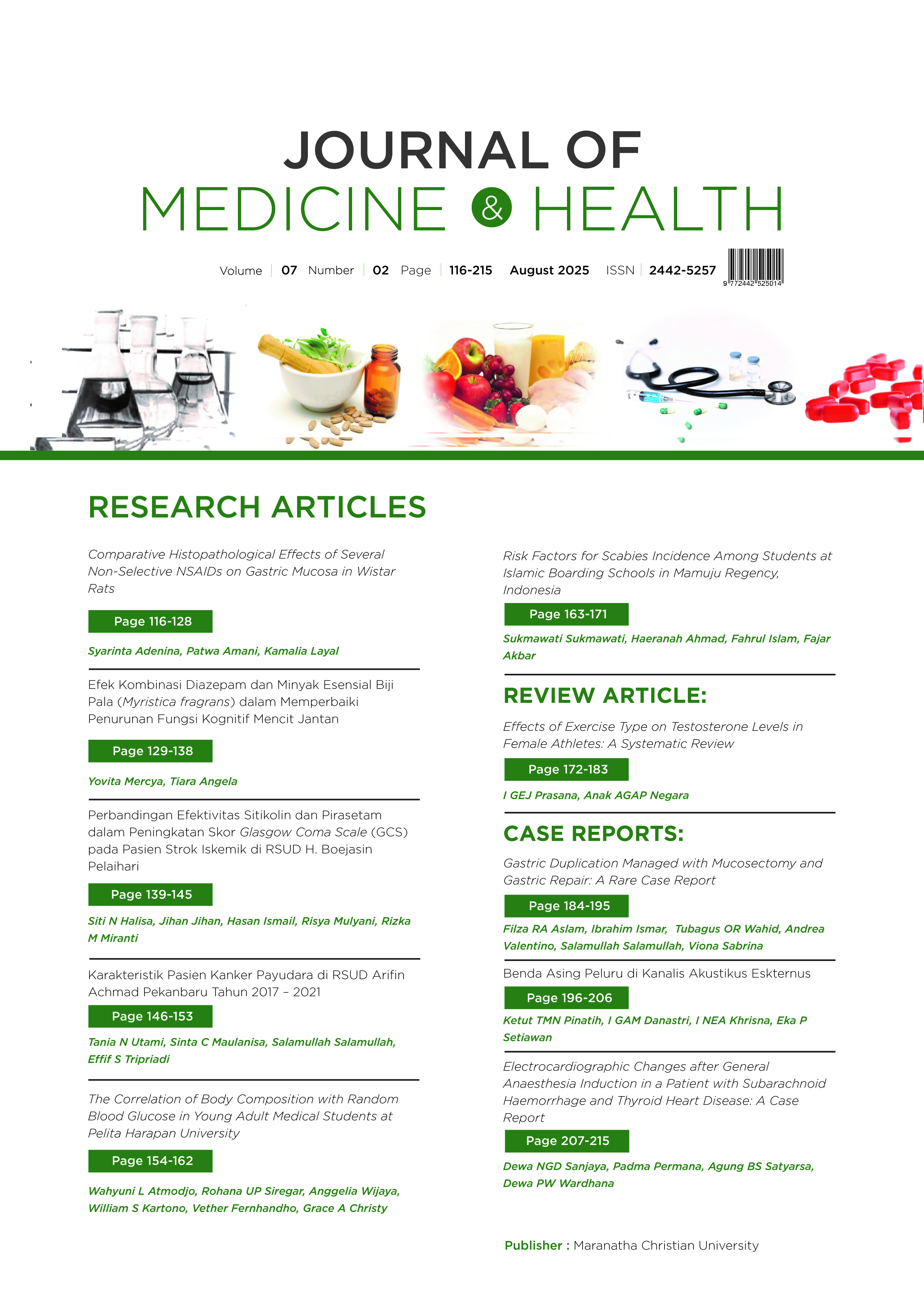
Electrocardiographic Changes after General Anaesthesia Induction in a Patient with Subarachnoid Haemorrhage and Thyroid Heart Disease: A Case Report
DOI:
https://doi.org/10.28932/jmh.v7i2.11506Keywords:
atrial fibrillation, fentanyl, propofol, subarachnoid haemorrhageAbstract
Electrocardiographic (ECG) abnormalities are commonly observed in patients with subarachnoid hemorrhage (SAH) and patients and are linked to worse outcomes. This case report documents the rapid normalization of severe ECG abnormalities following general anesthesia induction in a high-risk SAH patient with hyperthyroid heart disease. We report an 81-year-old woman with Fisher grade IV SAH and hyperthyroidism-associated cardiomyopathy who presented obtunded (GCS 7) with refractory atrial fibrillation at 116 bpm, diffuse T-wave inversions, and elevated troponin I. Following a multidisciplinary discussion, an External Ventricular Drain (EVD) was placed under general anesthesia using fentanyl, propofol, and rocuronium. This resulted in the immediate restoration of sinus rhythm, resolution of repolarization changes, and stabilization of blood pressure. Despite comprehensive ICU management—including analgesia, sedation, osmotherapy, steroids, and diuretics—the patient’s condition deteriorated within 24 hours, developing refractory intracranial hypertension and leading to death. This case highlights the autonomic-modulating and antiarrhythmic properties of anaesthetic agents in SAH-related neurocardiogenic dysfunction and underscores the need for further research into optimal anaesthesia strategies and patient outcomes.Downloads
References
Schatlo B, Fung C, Stienen MN, Fathi AR, Fandino J, Smoll NR, et al. Incidence and Outcome of Aneurysmal Subarachnoid Hemorrhage: The Swiss Study on Subarachnoid Hemorrhage (Swiss SOS). Stroke. 2021 ;52(1):344-7.
Suzuki K, Sato H, Sorimachi T, Fukuda H, Ueba T, Chin M, et al. Lack of association between chronological age and Fisher group and poor outcomes in older patients with severe-grade aneurysmal subarachnoid hemorrhage: a nationwide registry study in Japan. Neurosurg Rev. 2025 ;48(1):466. doi: 10.1007/s10143-025-03638-3. PMID: 40445438.
Chen M, Wang Z, Lai X, Wang S, Wu Z, Liu Q, et al. Transient cardiac electrophysiological changes in a rat model of subarachnoid haemorrhage: a brain-heart interaction. Europace. 2023;25(6):euad171.
Hu X, Li W, Ren B, Zeng R. Incidence of silent cerebral events detected by MRI in patients with atrial fibrillation undergoing pulsed field ablation vs thermal ablation: A systematic review and network meta-analysis. Heart Rhythm. 2025 :S1547-5271(25)02315-X.
Manikandan S. Cardiovascular manifestations of subarachnoid haemorrhage. J Neuroanaesth Crit Care. 2017;4:S38–S44.
Kerrigan LB, Stewart SA, Domínguez-Robles J, Brady AJ, Ammar AA, Donnelly RF, et al. Drug delivery systems for thyroid disease treatment: A mini review on current therapies and alternative approaches. Journal of Drug Delivery Science and Technology. 2023;87:104861.
Chatterjee S. ECG Changes in Subarachnoid Haemorrhage: A Synopsis. Neth Heart J. 2011;19(1):31–4.
Jonathan H, Michal C, Max F, Peter George B. Spontaneous subarachnoid hemorrhage: A primer for acute care practitioners. J Intensive Care Soc. 2025 :17511437251333269.
Gong C, Ding Y, Liang F, Wu S, Tang X, Ding H, et al.. Muscarinic receptor regulation of chronic pain-induced atrial fibrillation. Front Cardiovasc Med. 2022;9:934906.
Calvert P, Mills MT, Murray B, Kendall J, Ratnasingham J, Luther V, et al.. Feasibility of pulsed field ablation for atrial fibrillation under mild conscious sedation. J Interv Card Electrophysiol. 2024;1-8.
Bishop T, Khan W. Propofol for treatment of refractory ventricular tachycardia storm. Critical Care Medicine. 2025 ;53(1).
Hasegawa Y, Uchikawa H, Kajiwara S, Morioka M. Central sympathetic nerve activation in subarachnoid hemorrhage. J Neurochem. 2022;160(1):34–50.
Pinnamaneni S, Aronow WS, Frishman WH. Neurocardiac Injury After Cerebral and Subarachnoid Hemorrhages. Cardiol Rev.. 2017;25(2):89–95.
Yang L, Liu H, Sun HY, Li GR. Intravenous anesthetic propofol inhibits multiple human cardiac potassium channels. Anesthesiol. 2015;122(3):571–84.
Kunecki M, Oleksy T, Martynów J, Zygmunt M, Deja M, Kargul T, et al. Remifentanil but not sufentanil induces cardioprotection in human ischemic heart muscle in vitro. BMC Pharmacol Toxicol. 2023 ;24(1):25.
Peng J, Wu Y, Li L, Xia P, Yu P, Zhang J, et al. Dexmedetomidine vs. propofol on arrhythmia in cardiac surgery: a meta-analysis of randomized controlled trials. Front Cardiovasc Med. 2024 ;11:1433841.
Nakagawa Y, Kusayama T, Tamai S, Nagamori Y, Takeuchi K, Iwaisako S, et al. Association between skin sympathetic nerve activity and electrocardiogram alterations after subarachnoid hemorrhage. Physiol Rep. 2025 ;13(1):e70202.
Zhang X, Lei Y, Nan L, Dong S, Liu Y, Yu J, et al. QTc prolongation after aneurysmal subarachnoid hemorrhage might be associated with worse neurologic outcome in patients receiving microsurgical clipping or embolization of the intracranial aneurysms: a retrospective observational study. BMC Neurol. 2024 ;24(1):170. hilangkan.
Lele AV, Liu J, Kunapaisal T, Chaikittisilpa N, Kiatchai T, Meno MK, et al. Early Cardiac Evaluation, Abnormal Test Results, and Associations with Outcomes in Patients with Acute Brain Injury Admitted to a Neurocritical Care Unit. J Clin Med. 2024;13(9):2526.
Bilginer HA, Sogut O, Az A, Ergenc H. Electrocardiographic abnormalities are prognostic of the clinical outcomes and mortality of patients with subarachnoid hemorrhages. Am J Emerg Med. 2024 ;81:140-5.
Downloads
Published
How to Cite
Issue
Section
License
Copyright (c) 2025 Dewa NGD Sanjaya, Padma Permana, Agung BS Satyarsa, Dewa PW Wardhana

This work is licensed under a Creative Commons Attribution-NonCommercial 4.0 International License.
Authors who publish with this journal agree to the following terms:
- Authors retain the copyright and grant the journal right of first publication with the work
simultaneously licensed under a Creative Commons Attribution-NonCommercial 4.0 International License that allows others to share the work with an acknowledgement of the work's authorship and initial publication in this journal. - Authors are able to enter into separate, additional contractual arrangements for the nonexclusive distribution of the journal's published version of the work (e.g., post it to an institutional repository or publish it in a book), with an acknowledgement of its initial publication in this journal.
 This work is licensed under a Creative Commons Attribution-NonCommercial 4.0 International License.