
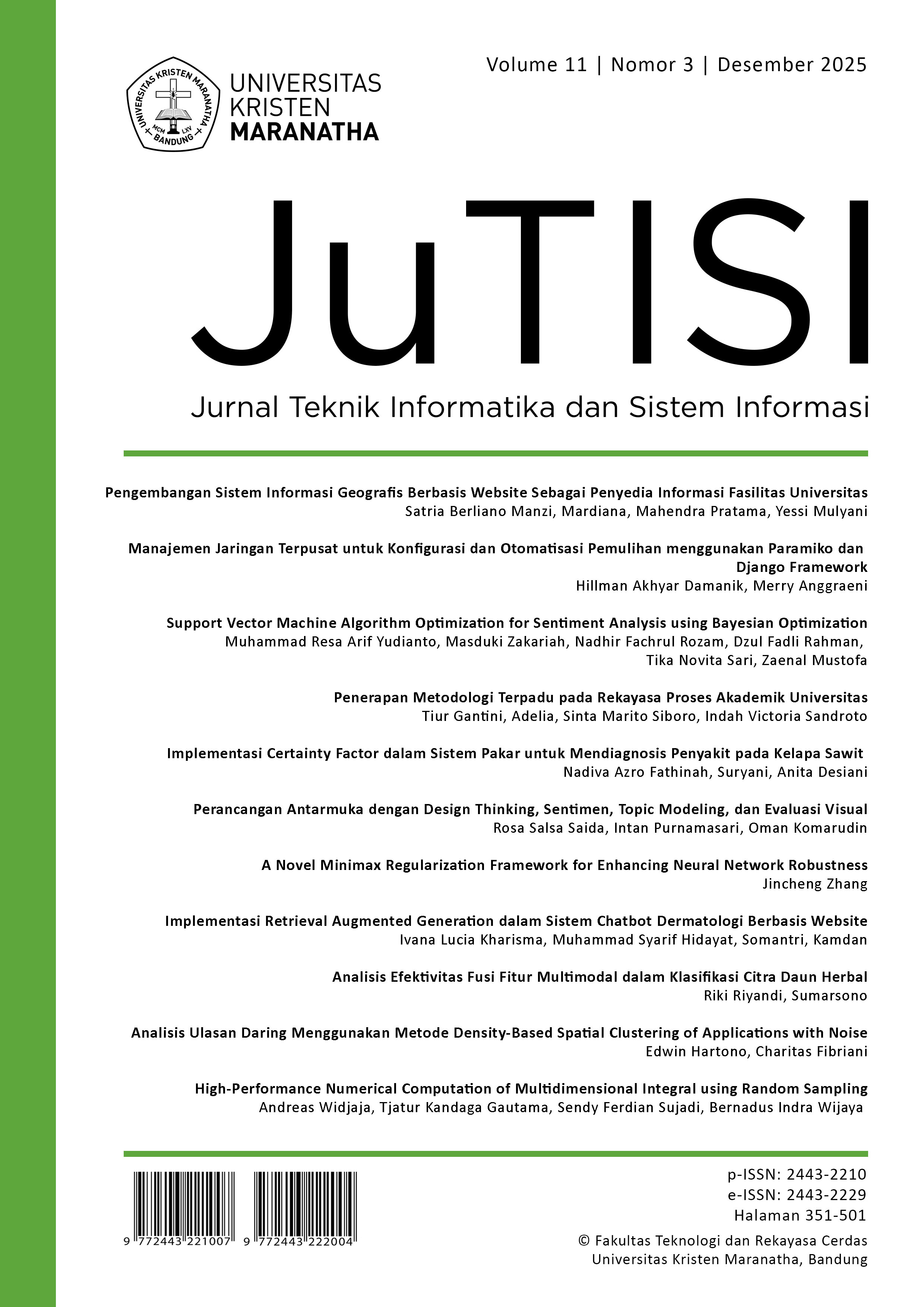
The Development of Web-Based Geographic Information System for University Facilities
Article Sidebar
Published:
Dec 15, 2025
Keywords:
Agile Scrum, Facilities, Geographic Information System, Usability Testing, Website Agile Scrum, Fasilitas, Sistem Informasi Geografis, Usability Testing, Website
Main Article Content
Abstract
The University of Lampung is one of the state universities in Lampung which has an area of around 65 hectares, has various facilities spread throughout the campus area. The diversity of facilities in the campus environment often causes difficulties for students and visitors in finding and recognizing these facilities, and it is very difficult and limited to get access and the location of the facilities. This study aims to develop a website-based Geographic Information System (GIS) that can be a source of information about facilities at the University of Lampung, test system functionality, and measure effectiveness, efficiency, and user satisfaction. System development uses the Agile Scrum method with 5 sprints. The system was developed using Next.js as the main framework, Leaflet.js for map visualization, and Supabase as a backend service. System testing is carried out through three methods: blackbox testing with decision table techniques, usability testing with 20 respondents, and heuristic evaluation by three expert evaluators. The test results showed that the system successfully completed 8 test items with 27 test combinations, achieving an effectiveness level of 97.5%, efficiency of 96.67%, and a user satisfaction score of 1,725 on a scale of 7 on the Post-Study System Usability Questionnaire (PSSUQ). The heuristic evaluation identified 22 problems which were then resolved through 18 recommendations for improvement. This system successfully provided detailed information on campus facilities and their locations accurately and can be easily accessed via the website.
Downloads
Download data is not yet available.
Article Details
How to Cite
[1]
S. B. Manzi, M. Mardiana, M. Pratama, and Y. Mulyani, “The Development of Web-Based Geographic Information System for University Facilities”, JuTISI, vol. 11, no. 3, pp. 351–368, Dec. 2025.
Section
Articles

This work is licensed under a Creative Commons Attribution-NonCommercial 4.0 International License.
This is an open-access article distributed under the terms of the Creative Commons Attribution-NonCommercial 4.0 International License (https://creativecommons.org/licenses/by-nc/4.0/) which permits unrestricted non-commercial used, distribution and reproduction in any medium.
This work is licensed under a Creative Commons Attribution-NonCommercial 4.0 International License.