
Analysis of Factors Contributing to Employee Attrition Based on Self-Organizing Map Clustering
Article Sidebar
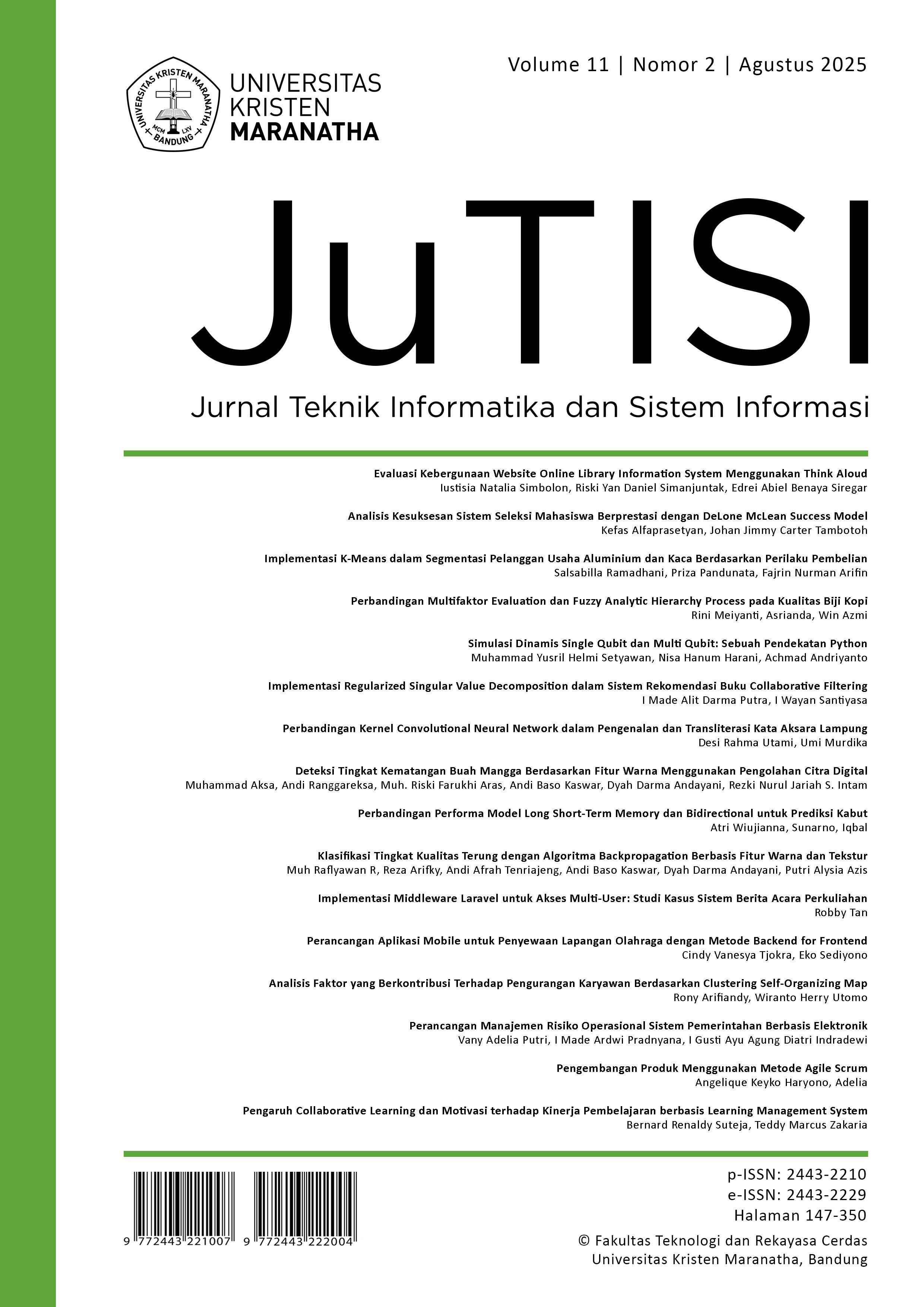
Published:
Aug 14, 2025
Keywords:
Self Organizing Map, Data Analysis, Data Mining, Clustering, Silhouette Score Clustering, Data Analysis, Data Mining, Self Organizing Maps, Silhouette Score
Main Article Content
Abstract
Employee turnover can disrupt the organization's operations and more or less cause losses to the business. Therefore, it is important to understand the causal factors so that organizations can take anticipatory action. Identify reasons employees leave their jobs is crucial for both employers and policy makers, especially when the goal is to prevent this from happening. Data on the causes of employee turnover is complex data that can have many dimensions, so a certain method is needed to analyze it. In this research, an analysis of data on the causes of employee turnover with 10 dimensions will be carried out using the Self Organizing Map (SOM) method. The Self-Organizing Map (SOM) is a technique for clustering and visualizing high-dimensional data by mapping it to a two-dimensional space while preserving the data's topological structure. This neural network-based method ensures that similar data points remain close to each other in the resulting 2D representation. SOM will cluster the data into several uniform groups. The results of this SOM grouping will be assessed with the Silhouette score, Dunn index and Connectivity value to determine how uniform the grouping is. Hopefully that by using the results of this SOM grouping, it shows that the clusters formed are very good and the data is clearly grouped. Therefore, we can analyze these groups with more accurate results.
Downloads
Download data is not yet available.
Article Details
How to Cite
[1]
R. Arifiandy and W. Herry Utomo, “Analysis of Factors Contributing to Employee Attrition Based on Self-Organizing Map Clustering”, JuTISI, vol. 11, no. 2, pp. 302 –, Aug. 2025.
Section
Articles

This work is licensed under a Creative Commons Attribution-NonCommercial 4.0 International License.
This is an open-access article distributed under the terms of the Creative Commons Attribution-NonCommercial 4.0 International License (https://creativecommons.org/licenses/by-nc/4.0/) which permits unrestricted non-commercial used, distribution and reproduction in any medium.
This work is licensed under a Creative Commons Attribution-NonCommercial 4.0 International License.