
Daily Nutritional Planning System Based on Portion Optimization and K-Means Clustering
Article Sidebar
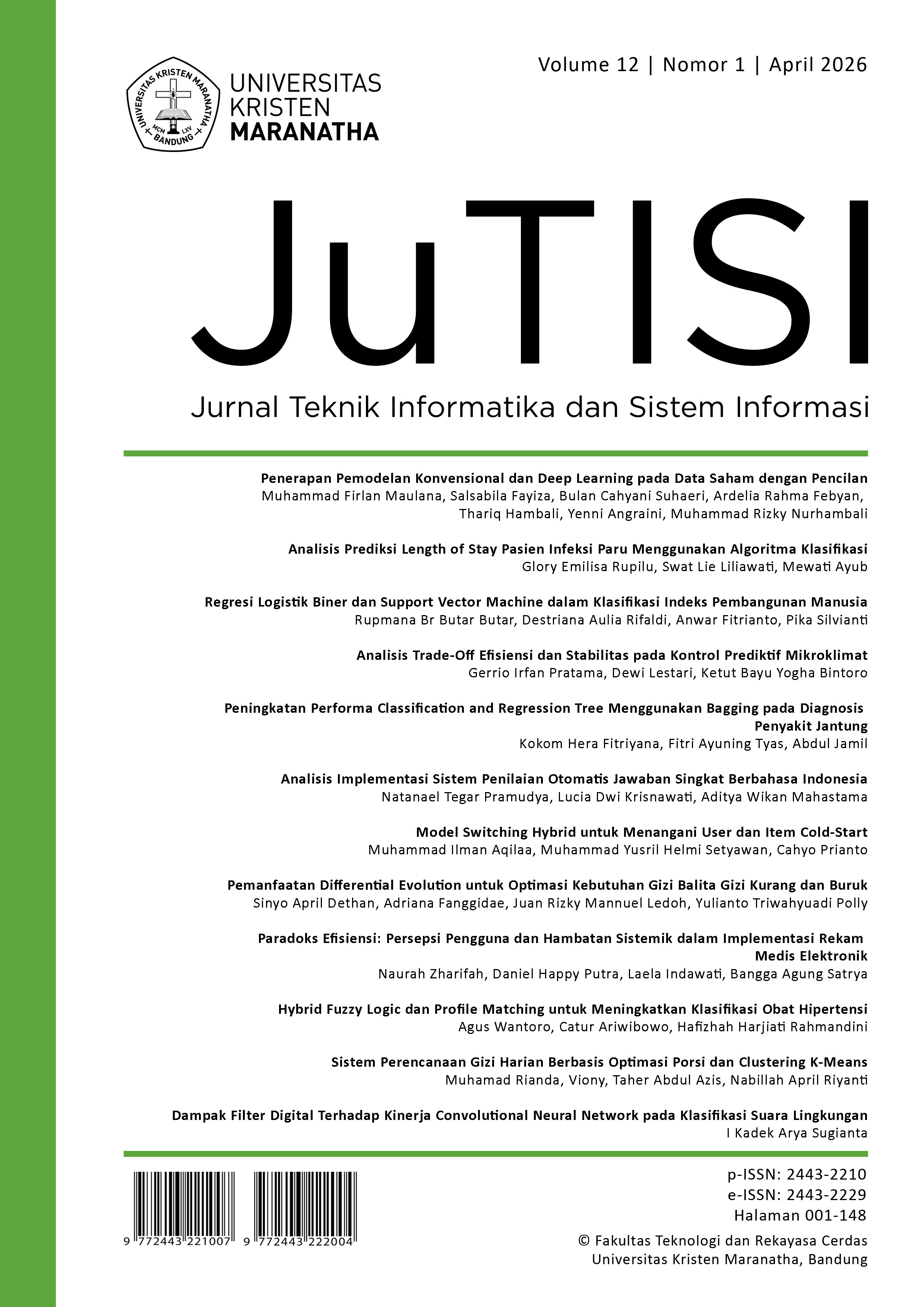
Published:
Apr 23, 2026
Keywords:
Daily Nutrition, Decision Support System, K-Means Clustering, Linear Programming, Portion Optimization Gizi Harian, K-Means Clustering, Optimasi Porsi, Pemrograman Linear, Sistem Pendukung Keputusan
Main Article Content
Abstract
Abstract — Personalized daily nutritional planning is a complex challenge due to the difficulty of translating individual nutritional needs into accurate food portions, exacerbated by the high prevalence of dual nutritional burdens in Indonesia. This study aims to design and implement an intelligent daily nutrition Decision Support System (DSS) capable of generating measured menu recommendations. The research method employs a hybrid approach, integrating an expert system knowledge base (Mifflin-St Jeor, FAO, IOM rules) with an inference engine based on dynamic portion optimization using linear programming (PuLP). Furthermore, unsupervised machine learning (K-Means) is applied to cluster food items to generate educational nutritional labels. The system was implemented as a web application using Python Flask and tested through case studies and functional verification. The main finding shows that the optimization engine successfully generated daily meal plans with specific grammages that closely approximated the target calories and macronutrients (case study caloric deviation <3%). The K-Means integration also proved effective in providing functional labels (e.g., "Pure Protein", "Energy Dense") for food items. This study concludes that a hybrid architecture based on dynamic portion optimization can provide a diet planning tool that is more quantitatively accurate and informative than traditional qualitative approaches.
Downloads
Download data is not yet available.
Article Details
How to Cite
[1]
M. Rianda, V. Viony, T. A. Azis, and N. A. Riyanti, “Daily Nutritional Planning System Based on Portion Optimization and K-Means Clustering”, JuTISI, vol. 12, no. 1, pp. 124–136, Apr. 2026.
Section
Articles

This work is licensed under a Creative Commons Attribution-NonCommercial 4.0 International License.
This is an open-access article distributed under the terms of the Creative Commons Attribution-NonCommercial 4.0 International License (https://creativecommons.org/licenses/by-nc/4.0/) which permits unrestricted non-commercial used, distribution and reproduction in any medium.
This work is licensed under a Creative Commons Attribution-NonCommercial 4.0 International License.