
Tomato Grade Classification Using You Only Look Once for Post-Harvest Sorting
Article Sidebar
Published:
Aug 27, 2026
Keywords:
Classification, detection, Post-harvest sorting, Precision agriculture, YOLOv8 Deteksi objek, Klasifikasi grade tomat, Penyortiran pascapanen, Pertanian presisi, YOLOv8
Main Article Content
Abstract
Tomatoes are one of the horticultural commodities with high economic value; however, quality grading in small-scale agricultural environments is still predominantly performed manually, leading to inconsistency, subjectivity, and high labor dependency. This study proposes a tomato grade classification system based on YOLOv8-Large to optimize post-harvest sorting at the farmer level. The dataset consists of 683 field images annotated using a polygon tool on the Roboflow platform, divided into 576 training images, 64 validation images, and 43 testing images. The model was trained using the AdamW optimizer with a batch size of 16 for 50 epochs. Evaluation results show a mAP@0.5 of 97.5% and a mAP@0.5:0.95 of 95.3%, with precision and recall values of 93.3% and 91.6%, respectively. During testing, the system processed approximately 40 tomatoes in ±2.5 seconds per container, improving sorting efficiency by approximately 97.2% compared to the manual method, which required around 90 seconds. These results demonstrate the potential of artificial intelligence to support precision agriculture and its integration into automated sorting systems such as conveyor-based solutions.
Downloads
Download data is not yet available.
Article Details
How to Cite
[1]
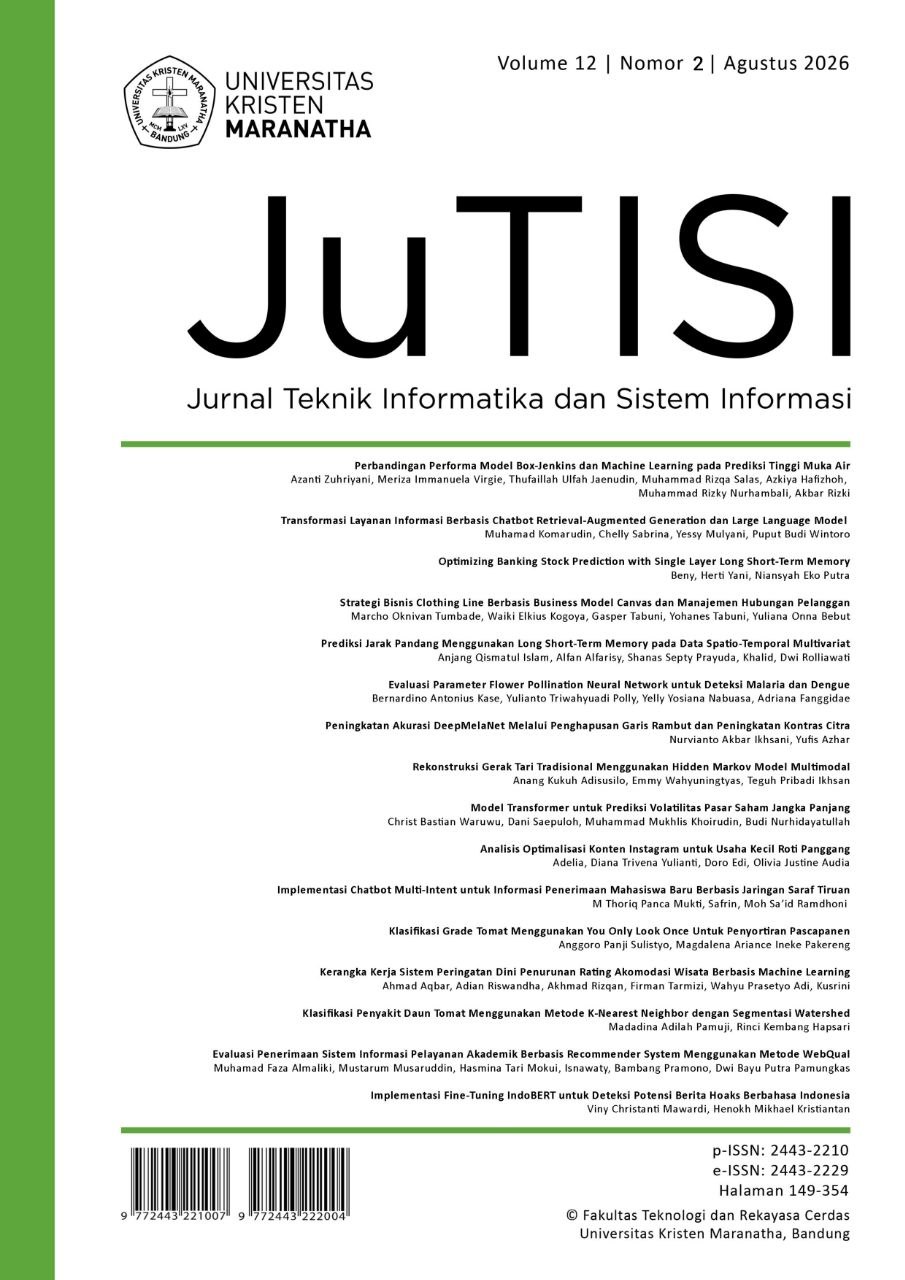
A. P. Sulistyo and M. A. I. Pakereng, “Tomato Grade Classification Using You Only Look Once for Post-Harvest Sorting”, JuTISI, vol. 12, no. 2, pp. 289–303, Aug. 2026.
Section
Articles

This work is licensed under a Creative Commons Attribution-NonCommercial 4.0 International License.
This is an open-access article distributed under the terms of the Creative Commons Attribution-NonCommercial 4.0 International License (https://creativecommons.org/licenses/by-nc/4.0/) which permits unrestricted non-commercial used, distribution and reproduction in any medium.
This work is licensed under a Creative Commons Attribution-NonCommercial 4.0 International License.