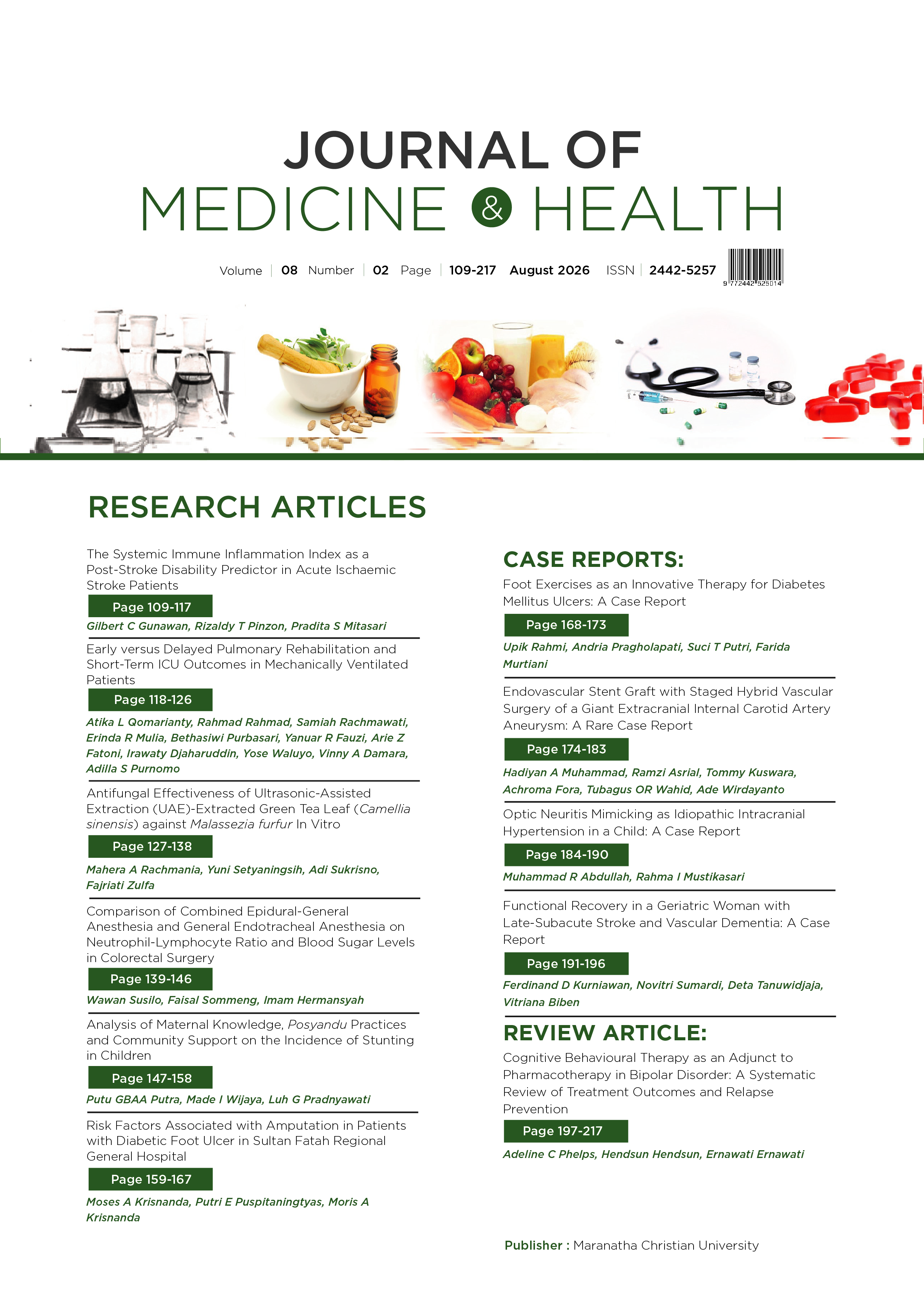
The Systemic Immune Inflammation Index as a Post-Stroke Disability Predictor in Acute Ischaemic Stroke Patients
DOI:
https://doi.org/10.28932/jmh.v8i2.11555Keywords:
acute ischemic stroke, Systemic Immune Inflammation Index, modified Rankin Scale, Barthel Index, post stroke disabilityAbstract
The Systemic Immune Inflammation (SII) Index is a biomarker that may help predict stroke prognosis. However, studies on the SII Index are still limited, particularly in Indonesia. The purpose of this study was to measure the SII Index as a predictor factor of disability-prognosis for acute ischemic stroke patients. This study used a retrospective cohort design. Subjects’ data (112 subjects) were collected from STROKE REGISTRY RS Bethesda Yogyakarta. In this study, the independent variable was SII Index, whereas the dependent variables were mRS and BI. SII Index was analysed via ROC/AUC with mRS output to find the best cut-off value. Bivariate analyses were performed using the Spearman rho test to observe the correlation between risk factors and clinical outcomes. Risk factors with significant correlations would be re-analyzed with regression tests to observe the correlations affected by one another. Of 112 patients, the best cut-off for SII Index was 773.242 (sensitivity 92.9%; specificity 62.2%). Significant correlations were found between the SII Index and stroke severity with both mRS and BI (p < 0.01 for all). Significant results were shown on the regression tests between the SII Index and both mRS and BI (p < 0.01 for all). SII Index has been proven as a predictor factor of disability-prognosis for acute ischaemic stroke.Downloads
References
Coupland AP, Thapar A, Qureshi MI, Jenkins H, Davies AH. The Definition of Stroke. J R Soc Med. 2017;110(1):9–12.
Hong KS, Saver JS. Years of Disability-Adjusted Life Gained as a Result of Thrombolytic Therapy for Acute Ischemic Stroke. Stroke. 2010;41(3):471–7.
Feigin VL, Brainin M, Norrving B, Martins SO, Pandian J, Lindsay P, et al. World Stroke Organization: Global Stroke Fact Sheet 2025. Int J Stroke. 2025;20(2):132–44.
Adityasiwi GL, Budiono I, Zainafree I, Cahyati WH. Stroke in Indonesia: An epidemiological overview. Phys Ther J Indones. 2025;6(1):70–3.
Wang N, Yang Y, Qiu B, Gao Y, Wang A, Xu Q, et al. Correlation of the systemic immune-inflammation index with short- and long-term prognosis after acute ischemic stroke. Aging. 2022;14(16):6567–78.
Maida CD, Norrito RL, Daidone M, Tuttolomondo A, Pinto A. Neuroinflammatory mechanisms in ischemic stroke: Focus on cardioembolic stroke, background, and therapeutic approaches. Int J Mol Sci. 2020;21(18):1–33.
Murphy K, Weaver C, Berg L. Janeway’s Immunobiology. 10th ed. Twitchell B, Bressack CB, editors. New York: W. W. Norton & Company, Inc.; 2022. p. 103.
Lasek-Bal A, Jedrzejowska-Szypulka H, Student S, Warsz-Wianecka A, Zareba K, Puz P, et al. The importance of selected markers of inflammation and blood-brain barrier damage for short-term ischemic stroke prognosis. J Physiol Pharmacol. 2019;70(2).
Hu J, Wang L, Fan K, Ren W, Wang Q, Ruan Y, et al. The association between systemic inflammatory markers and post-stroke depression: A prospective stroke cohort. Clin Interv Aging. 2021;16:1231–9.
Gardener H, Romano LA, Smith EE, Campo-Bustillo I, Khan Y, Tai S, et al. Functional status at 30 and 90 days after mild ischaemic stroke. Stroke Vasc Neurol. 2022;7(5):375–80. doi:10.1136/svn-2021-001333.
Wijayanti IG, Pinzon RT, Pramudita EA. Faktor Prediktor Luaran Disabilitas Pada Pasien Stroke Iskemik di Rumah Sakit Bethesda Yogyakarta. Neurona. 2020;36(4):310–5.
Weng Y, Zeng T, Huang H, Ren J, Wang J, Yang C, et al. Systemic immune-inflammation index predicts 3-month functional outcome in acute ischemic stroke patients treated with intravenous thrombolysis. Clin Interv Aging. 2021;16:877–86.
Trevissón-Redondo B, López-López D, Pérez-Boal E, Marqués-Sánchez P, Liébana-Presa C, Navarro-Flores E, et al. Use of the Barthel Index to assess activities of daily living before and after SARS-CoV-19 infection in institutionalized nursing home patients. Int J Environ Res Public Health. 2021;18(14).
Zhou S, Chen J, Cheng L, Fan K, Xu M, Ren W, et al. Age-Dependent Association Between Elevated Homocysteine and Cognitive Impairment in a Post-stroke Population: A Prospective Study. Front Nutr. 2021;8.
Endres M, Moro MA, Nolte CH, Dames C, Buckwalter MS, Meisel A. Immune pathways in etiology, acute phase, and chronic sequelae of ischemic stroke. Circ Res. 2022;130(8):1167–86.
Cai W, Liu S, Hu M, Huang F, Zhu Q, Qiu W, et al. Functional Dynamics of Neutrophils After Ischemic Stroke. Transl Stroke Res. 2020;11(1):108–21.
Kuklina EM. Molecular mechanisms of T-cell anergy. Biochemistry (Moscow). 2013;78(2):144–56.
Micó GD, Soto-Heredero G, Aranda JF, Oller J, Carrasco E, Gabandé-Rodríguez E, et al. T cells with dysfunctional mitochondria induce multimorbidity and premature senescence. Science. 2020;368(6497):1371–6. doi:10.1126/science.aax0860.
Rexrode KM, Madsen TE, Yu AYX, Carcel C, Lichtman JH, Miller EC. The Impact of Sex and Gender on Stroke. Circ Res. 2022;130(4):512–28.
Mosenzon O, Cheng AYY, Rabinstein AA, Sacco S. Diabetes and Stroke: What Are the Connections? J Stroke. 2023;25(1):26–38.
Huber CC, Wang X, Wang H. Impact of Cardiovascular Diseases on Ischemic Stroke Outcomes. J Integr Neurosci. 2022;21(5).
Wang T, Chen L, Yang T, Huang P, Wang L, Zhao L, et al. Congenital Heart Disease and Risk of Cardiovascular Disease: A Meta-Analysis of Cohort Studies. J Am Heart Assoc. 2019;8(10):126
Mi D, Wang P, Yang B, Pu Y, Yang Z, Liu L. Correlation of hyperglycemia with mortality after acute ischemic stroke. Ther Adv Neurol Disord. 2018;11.
Tsivgoulis G, Katsanos AH, Mavridis D, Lambadiari V, Roffe C, MacLeod MJ, et al. Association of baseline hyperglycemia with outcomes of patients with and without diabetes with acute ischemic stroke treated with intravenous thrombolysis: A propensity score-matched analysis from the SITS-ISTR registry. Diabetes. 2019;68(9):1861–9.
Chu YW, Chen PY, Lin SK. Correlation between Immune-Inflammatory Markers and Clinical Features in Patients with Acute Ischemic Stroke. Acta Neurologica Taiwanica. 2020;29(4):103–13.
Fuentes B. Antidiabetic drugs for stroke prevention in patients with type-2 diabetes. The neurologist’s point of view. Medicina Clínica (English Edition). 2018;50(7):275–81.
Hewitt J, Castilla Guerra L, Fernandez-Moreno MDC, Sierra C. Diabetes and stroke prevention: A review. Stroke Res Treat. 2012;673187.
Lloyd-Jones DM, Hong Y, Labarthe D, Mozaffarian D, Appel LJ, Van Horn L, et al. Defining and setting national goals for cardiovascular health promotion and disease reduction: The American Heart Association’s strategic impact goal through 2020 and beyond. Circulation. 2010;121(4):586–613.
Agunloye AM, Owolabi MO. Exploring carotid sonographic parameters associated with stroke risk among hypertensive stroke patients compared to hypertensive controls. J Ultrasound Med. 2014;33(6):975–83.
Stuckey SM, Ong LK, Collinss-praino LE, Turner RJ. Neuroinflammation as a key driver of secondary neurodegeneration following stroke? Int J Mol Sci. 2021;22(23).
Muscari A, Falcone R, Recinella G, Faccioli L, Forti P, Pastore Trossello M, et al. Prognostic significance of diabetes and stress hyperglycemia in acute stroke patients. Diabetol Metab Syndr. 2022;14(1).
Peacock JL, Peacock PJ. Oxford Handbook of Medical Statistics. 2nd ed. New York: Oxford University Press; 2020.
Huang L. Increased Systemic Immune-Inflammation Index Predicts Disease Severity and Functional Outcome in Acute Ischemic Stroke Patients. Neurologist. 2023;28(1):32–8.
Wu S, Shi X, Zhou Q, Duan X, Zhang X, Guo H. The Association between Systemic Immune-Inflammation Index and All-Cause Mortality in Acute Ischemic Stroke Patients: Analysis from the MIMIC-IV Database. Emerg Med Int. 2022;2022:4156489.
Downloads
Published
How to Cite
Issue
Section
License
Copyright (c) 2026 Gilbert C Gunawan, Rizaldy T Pinzon, Pradita S Mitasari

This work is licensed under a Creative Commons Attribution-NonCommercial 4.0 International License.
Authors who publish with this journal agree to the following terms:
- Authors retain the copyright and grant the journal right of first publication with the work
simultaneously licensed under a Creative Commons Attribution-NonCommercial 4.0 International License that allows others to share the work with an acknowledgement of the work's authorship and initial publication in this journal. - Authors are able to enter into separate, additional contractual arrangements for the nonexclusive distribution of the journal's published version of the work (e.g., post it to an institutional repository or publish it in a book), with an acknowledgement of its initial publication in this journal.
 This work is licensed under a Creative Commons Attribution-NonCommercial 4.0 International License.