
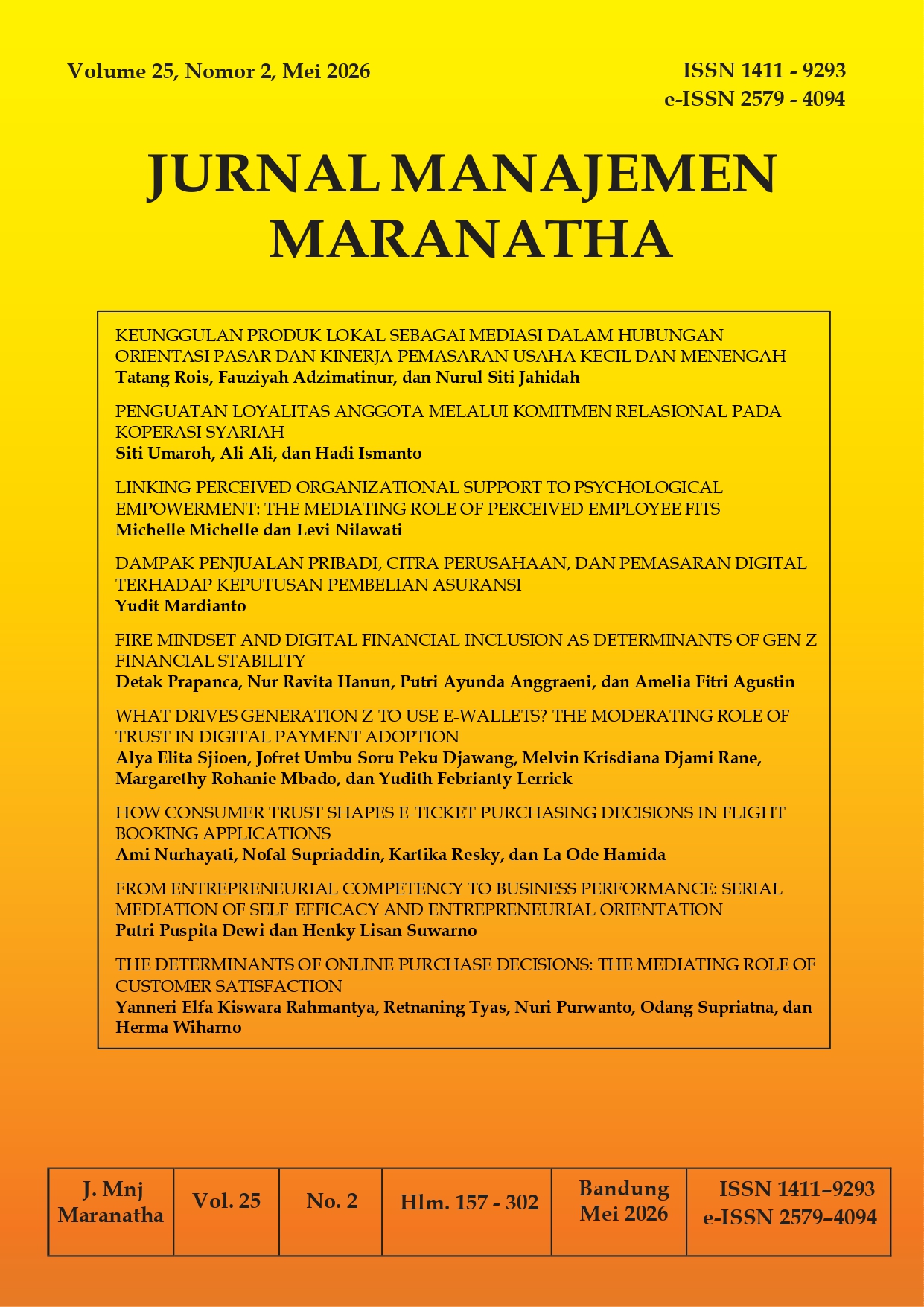
What drives Generation Z to use e-wallets? The moderating role of trust in digital payment adoption
Article Sidebar
Main Article Content
Abstract
Downloads
Article Details

This work is licensed under a Creative Commons Attribution-NonCommercial 4.0 International License.
References
Agárdi, I., & Alt, M. A. (2024). Do digital natives use mobile payment differently than digital immigrants? A comparative study between generation X and Z. Electronic Commerce Research, 24, 1463-1490. https://doi.org/10.1007/s10660-022-09537-9
Ariningsih, E. P., Wijayanti, W., & Prasaja, M. G. (2022). Intention to use e-wallet dilihat dari perceived usefulness, perceived ease of use, perceived security, dan trust. Jurnal Maksipreneur: Manajemen, Koperasi, dan Entrepreneurship, 11(2), 227-238. https://doi.org/10.30588/jmp.v11i2.916
Belmonte, Z. J. A., Prasetyo, Y. T., Cahigas, M. M. L., Nadlifatin, R., & Gumasing, M. J. J. (2024). Factors influencing the intention to use e-wallet among Generation Z and Millennials in the Philippines: An extended technology acceptance model (TAM) approach. Acta Psychologica, 250. https://doi.org/10.1016/j.actpsy.2024.104526
Casanova, M., & Nugroho, A. T. (2024). Interest in using Ovo: The role of trust in mediating security and perceived ease of use. JIM: Jurnal Ilmu Manajemen, 21(1), 26-41. https://jurnal.uny.ac.id/index.php/jim/article/view/73588
Cong, M. V. H., Nguyen, C. H., Nhu, L. T., & Tran, T. T. (2024). A study on the impacts of safety and security on consumer’s intention to use electronic wallets in Hanoi. Innovative Marketing, 20(4), 85-99. https://doi.org/10.21511/im.20(4).2024.08
Daradinanti, R., & Sari, D. (2025). The influence of e-wallet usage in triggering impulse buying: A comparative study between Gen X and Gen Z consumers in Bandung. JBSMR: Journal of Business Studies and Management Review, 8(2), 330-337. https://online-journal.unja.ac.id/jbsmr/article/view/47372
Davis, F. D. (1993). User acceptance of information technology: System characteristics, user perceptions, and behavioral impacts. International Journal of Man-Machine Studies, 38(3), 475-487. https://doi.org/10.1006/imms.1993.1022
Do, A. D., Ha, D. L., Nguyen, A. T., Le, M. D., Nguyen, M. H. N., & Dang, A. Q. (2025). Digital transformation of online payments: Interface design and customer service roles in e-wallet adoption in Vietnam. Cogent Business & Management, 12(1). https://doi.org/10.1080/23311975.2025.2557966
Fitriani, D., & Astuti, P. (2024). Antecedent factors of intention to use digital wallets and the moderating role of consumer trust. FJSR: Formosa Journal of Sustainable Research, 3(2), 329-354. https://doi.org/10.55927/fjsr.v3i2.8127
Fitriati, A., Tubastuvi, N., Mudjiyanti, R., Wahyuni, S., & Ibarra, V. C. (2024). Mobile banking acceptance model for Generation Z: The role of trust, self-efficacy, and enjoyment. Journal of Accounting and Investment, 25(3), 1109-1132. https://doi.org/10.18196/jai.v25i3.21639
Gómez-Hurtado, C., Gálvez-Sánchez, F. J., Prados-Pena, M. B., & Ortíz-Zamora, A. F. (2025). Adoption of e-wallets: Trust and perceived risk in Generation Z in Colombia. Spanish Journal of Marketing, 29(4), 425-443. https://doi.org/10.1108/SJME-01-2024-0017
Gusmiarti, I., Farida, N., & Wijayanto, A. (2025). Pengaruh perceived usefulness dan e-trust terhadap intention to use e-wallet Dana. Jurnal Ilmu Administrasi Bisnis, 14(1), 21-33. https://doi.org/10.14710/jiab.2025.44916
Haedar, S., & Marsasi, E. G. (2025). How perceived usefulness, ease of use, and quality affect e-wallet intention in Gen Y and Z: A TAM perspective. Sentralisasi, 14(2), 70-98. https://doi.org/10.33506/sl.v14i2.4233
Hair, J. , Hult, G. T. M., Ringle, C. M., Sarstedt, M., Danks, N. P., & Ray, S. (2021). An introduction to partial least squares structural equation modeling (PLS-SEM) using R. Springer, Cham. https://doi.org/https://doi.org/10.1007/978-3-030-80519-7_1
Hapsoro, B. B., & Kismiatun, K. (2022). The effect of perceived ease of use, perceived usefulness, and perceived security on e-wallet continuance intention of ShopeePay through e-satisfaction. Management Analysis Journal, 11(4), 395-405. https://journal.unnes.ac.id/sju/maj/article/view/63725
Indriartiningtias, R., Permatasari, D. A., Ilhamsyah, H. A., Agustina, F., & Novianti, T. (2025). The influence of trust, perceived usefulness, attitude, and promotion on e-wallet adoption among Generation Z in Bangkalan, Indonesia. AIPTEC: AI-Integrated Physics, Technology, and Engineering Conference, 344, 1-6. https://doi.org/10.1051/epjconf/202534401046
Karsim, K., Rini, R., Ronaldo, R., Anam, S., & Judijanto, L. (2024). The perception of security and risk, ease of use, and benefits are the determining factors in adopting a digital wallet. Journal of Management: Small and Medium Enterprises (SMEs), 17(2), 525-535. https://doi.org/10.35508/jom.v17i2.17027
Khan, W. A., & Abideen, Z. U. (2023). Effects of behavioural intention on usage behaviour of digital wallet: The mediating role of perceived risk and moderating role of perceived service quality and perceived trust. Future Business Journal, 9, 1-15. https://doi.org/10.1186/s43093-023-00242-z
Kilani, A. A. -H. Z., Kakeesh, D. F., Al-Weshah, G. A., & Al-Debei, M. M. (2023). Consumer post-adoption of e-wallet: An extended UTAUT2 perspective with trust. Journal of Open Innovation: Technology, Market, and Complexity, 9(3). https://doi.org/10.1016/j.joitmc.2023.100113
Kumara, K., & Laksmidewi, D. (2024). The effect of perceived risk on intention to use of e-wallet in Jabodetabek with the mediation of perceived usefulness and perceived ease of use. JBSMR: Journal of Business Studies and Management Review, 8(1), 63-70. https://doi.org/10.22437/jbsmr.v8i1.38259
Kurniawan, S., & Tankoma, A. (2023). The effect of perceived ease of use and perceived enjoyment on customer trust and loyalty in online food delivery service. Binus Business Review, 14(2), 163-170. https://journal.binus.ac.id/index.php/bbr/article/view/8874
Lestari, E. A., & Siagian, D. (2021). Adapting technology adoption model to detect intention to use Tiket.com’s online ticketing application. Jurnal Ekonomi Perusahaan, 28(1), 62-73. https://doi.org/10.46806/jep.v28i1.821
Lim, W. M. (2024). A typology of validity: Content, face, convergent, discriminant, nomological, and predictive validity. Journal of Trade Science, 12(3), 155-179. https://doi.org/10.1108/jts-03-2024-0016
Matar, A., & Aloqaily, A. N. (2025). The mediating influence of perceived usefulness on consumer behaviour towards driving e-wallet adoption in Jordan. Journal of Open Innovation: Technology, Market, and Complexity, 11(4). https://doi.org/10.1016/j.joitmc.2025.100651
Munadia, M., Umuri, K., Sentosa, D. S., & Nurlina, E. (2024). Determinant of purchase decisions in TikTok shop e-commerce with trust as a mediating Variable. Jimebis: Scientific Journal of Students Islamic Economics and Business, 5(1), 13-23. https://jim.ar-raniry.ac.id/index.php/JIMEBIS/article/view/534
Narendrar, N. A., Suseno, J. E., & Nugraheni, D. M. K (2023). Factors influencing interest in continuing use of e-wallet using the Technology Acceptance Model and task-technology fit. Jurnal Mimbar Ilmu, 28(2), 221-230. https://doi.org/10.23887/mi.v28i2.61228
Nawi, S. V., Riwu, Y. F., & Aman, D. K. T. (2025). How does e-wallets influence consumptive behaviour: The role of perceived ease of use and security. Eco-Buss: Economics and Business, 8(2), 1641-1652. https://doi.org/10.32877/eb.v8i2.3237
Nguyen, V. C., & Ao, T. H. (2022). Factors affecting consumer behaviour to use e-wallets: An empirical study from Vietnam context. Vmost: Journal of Social Sciences and Humanities, 64(1), 10-24. https://vjol.info.vn/index.php/mostd/article/view/67310
Nursjanti, F., & Amaliawiati, L. (2025). Factors influencing continuance intention of ShopeePay e-wallet among Generation Z. International Journal of Management and Economics Invention, 11(12), 4883-4893. https://doi.org/10.47191/ijmei/v11i12.04
Nuryasman, M. N., & Warningsih, S. (2021). Determining factors of digital wallet usage. Jurnal Manajemen, 25(2), 271-289. https://doi.org/10.24912/jm.v25i2.740
Prasetyani, A., Mustika, M. D., Sjabadhyni, B., Adira, N., Dali, N. R. S. B. M., & Nandan, M. (2024). Unlocking paylater preferences: Exploring Gen z’s trust dynamics in Indonesia and Malaysia. Cogent Psychology, 11(1). https://doi.org/10.1080/23311908.2024.2352962
Putri, N. A., & Nurabiah, N. (2024). Determinan penggunaan e-wallet DANA sebagai alat transaksi di kalangan mahasiswa akuntansi Universitas Mataram. JAKK: Jurnal Akuntansi dan Keuangan Kontemporer, 7(1), 17-29. https://doi.org/10.30596/jakk.v7i1.18554
Rahmi, L. D. A., & Maulana, A. (2025). The influence of trust, perceived usefulness, perceived ease of use, perceived risk, and perceived security on continuance intention e-wallet ShopeePay on Generation Z in Padang city mediated by consumer attitude and consumer engagement. Santhet: Jurnal Sejarah, Pendidikan, dan Humaniora, 9(1), 337-351. https://ejournal.unibabwi.ac.id/index.php/santhet/article/view/5039
Ramadhanti, S. P., Buchdadi, A. D., & Fawaiq, M. (2023). Determinan adopsi dompet digital: Perceived ease of use, trust, dan perceived usefulness. Jurnal Bisnis, Manajemen, dan Keuangan, 4(1), 75-85. https://journal.unj.ac.id/unj/index.php/jbmk/article/view/33611
Rante, Y., & Toii, I. E. W. (2025). The influence of perceived usefulness, ease of use, security, and trust on Intention to use Dana e-wallet. Jimkes: Jurnal Ilmiah Manajemen Kesatuan, 13(5), 2815-2826. https://doi.org/10.37641/jimkes.v13i5.3877
Ranti, N. Q., Agung, D. A., & Ellitan, L. (2023). The impact of security and e-WoM to purchase decision with trust as mediator in online shopping through the Shopee application. APMRC: Proceedings of the 4th Asia Pacific Management Research Conference, 346-359. https://doi.org/10.2991/978-94-6463-076-3_26
Rashid, M., Shamsi, M. A., Anwar, I., Saleem, I., & Yahya, A. T. (2025). Consumer intention to adopt e-wallets in rural India: An investigation by extending the Technology Acceptance Model. Cogent Business & Management, 12(1). https://doi.org/10.1080/23311975.2024.2428776
Riza, A. A., & Aditya, A. (2025). Evaluating the impact of trust and security on e-wallet adoption: Insights from the UTAUT2 model in Indonesia. Jurnal SimanteC, 13(2), 101-110. https://doi.org/10.21107/simantec.v13i2.29623
Rizkyla, Z., Meuthia, R. F., & Rosita, I. (2024). The influence of perceived ease of use, perceived usefulness, and trust as intervening variables on interest in using digital banks among Millennial Generation (Gen Y) and Generation Z (Gen Z). Jurnal Riset Akuntansi Politala, 7(1), 94-107. https://doi.org/10.34128/jra.v7i1.272
Roosdhani, M. R., Arifin, S., Komaryatin, N., Ali, A., Huda, N., & Khoiruddin, M. (2025). Generation Z decision to use e-wallets and its drivers. Economics & Business Solutions Journal, 9(2), 182-198. https://doi.org/10.26623/ebsj.v9i2.11982
Salma, S. N., & Permatasari, D. (2025). Investigating e-wallet adoption among Gen Z students: Determinants of behavioral intention and actual use. JED: Journal of Enterprise and Development, 7(1), 192-205. https://doi.org/10.20414/jed.v7i1.13106
Sandy, E., & Firdausy, C. M. (2021). Pengaruh perceived usefulness, perceived ease of use, dan trust terhadap minat konsumen dalam penggunaan ulang GoPay di kota Jakarta. Jurnal Manajemen Bisnis dan Kewirausahaan, 5(1), 22-27. https://doi.org/10.24912/jmbk.v5i1.10275
Saputra, I. A. G., Yusuf, A., Hakim, L., & Rohayati, S. (2023). Determination of Generation Z’s intention in using e-wallet for payment transactions. E-Jurnal Akuntansi, 33(1), 73-86. https://www.researchgate.net/publication/368239332
Sopiyah, S., & Sriyono, S. (2025). The cashless society trend: Examining the influence of e-wallet usage among Generation Z. International Islamic Business and Management Review, 5(1), 13-28. https://doi.org/10.54099/ijibmr.v5i1.1343
Sukwadi, R., Caroline, L. S., & Chen, G. Y. -H. (2022). Extended Technology Acceptance Model for Indonesian mobile wallet: Structural equation modeling approach. Engineering and Applied Science Research, 49(2), 146-154. https://doi.org/10.14456/easr.2022.17
To, A. T., & Trinh, T. H. M. (2021). Understanding behavioral intention to use mobile wallets in Vietnam: Extending the TAM model with trust and enjoyment. Cogent Business & Management, 8(1). https://doi.org/10.1080/23311975.2021.1891661
Ulum, I. F., & Solekah, N. A. (2024). The impact of lifestyle, financial literacy, and ease of use of e-payment on e-wallet users’ consumptive behavior in the Millennial Generation. MEC-J: Management and Economics Journal, 8(1), 67-82. https://doi.org/10.18860/mec-j.v8i1.26265
Wang, X., & Yu, X. (2024). Art students’ technostress, perceived usefulness, satisfaction, and continuance intention to use mobile educational applications. SAGE Open, 14(2), 1-11. https://doi.org/10.1177/21582440241260206
Zuniatami, A. L., & Mahardhika, A. S. (2025). The role of perceived security in e-wallet adoption using TAM among Generation Z. Journal of E-Bis: Economics-Business, 9(2), 802-817. https://doi.org/10.37339/e-bis.v9i2.2263