
Interface Redesign Using Design Thinking, Sentiment, Topic Modeling, and Visual Evaluation
Article Sidebar
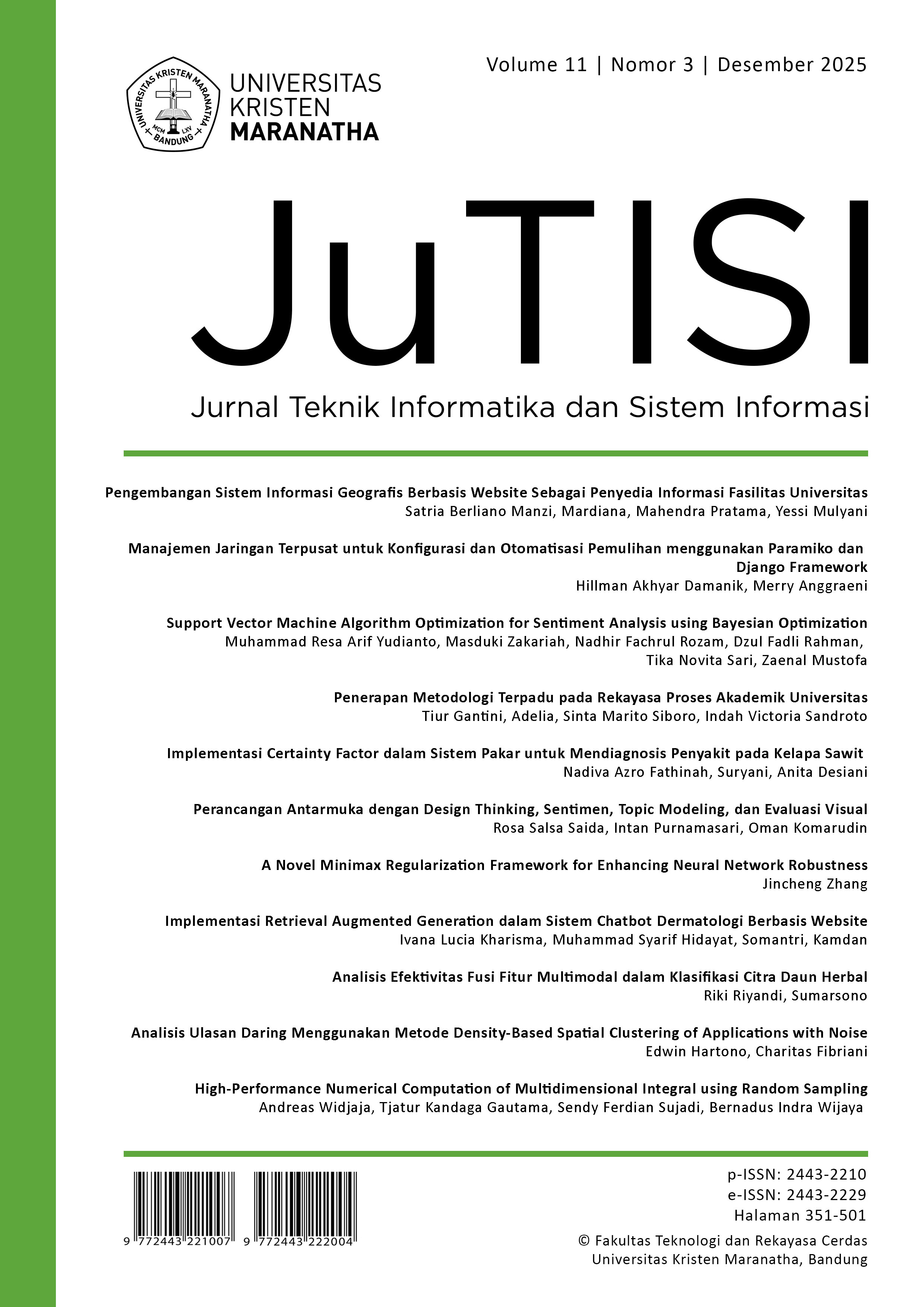
Published:
Dec 15, 2025
Keywords:
Deign Thinking, Gestalt Heuristik Nielsen, Latent Dirichlet Allocation, VADER Design Thinking, Gestalt Heuristik Nielsen, Latent Dirichlet Allocation, VADER
Main Article Content
Abstract
The digitalization era encourages the presence of various application-based services, including online shopping services. One such platform is FamiApps by FamilyMartID, developed as a convenient tool for ordering Family Mart Indonesia products. However, a low rating of 2.29 based on the latest data from Google Play Store indicates user dissatisfaction, which falls to capture the full scope of user concerns. This study aims to redesign the user interface (UI) and user experience (UX) of FamiApps by implementing Design Thinking, focusing on user needs. In the Empathize stage, sentiment analysis was conducted using the VADER method on 266 user reviews to identify negative sentiments, which were then further analyzed using Latent Dirichlet Allocation (LDA) to identify pain points. These findings served as the poundation for the Define stage to formulate user needs, followed by the Ideate and Prototype stages, incorporating Nielsen’s heuristics and Gestalt principles as interface design guidelines. The final design was evaluated using the System Usability Scale (SUS) with 35 respondents, resulting in a score of 82, categorized as “Excellent” in adjective ratings, “Acceptable” in acceptable ratings, and graded “A” in the grade scale. The findings demonstrate that a review-driven design approach can produce UI/UX solutions that are more relevant, adaptive, and contribute to enhancing user experience quality.
Downloads
Download data is not yet available.
Article Details
How to Cite
[1]
R. S. Saida, I. . Purnamasari, and O. Komarudin, “Interface Redesign Using Design Thinking, Sentiment, Topic Modeling, and Visual Evaluation”, JuTISI, vol. 11, no. 3, pp. 415–434, Dec. 2025.
Section
Articles

This work is licensed under a Creative Commons Attribution-NonCommercial 4.0 International License.
This is an open-access article distributed under the terms of the Creative Commons Attribution-NonCommercial 4.0 International License (https://creativecommons.org/licenses/by-nc/4.0/) which permits unrestricted non-commercial used, distribution and reproduction in any medium.
This work is licensed under a Creative Commons Attribution-NonCommercial 4.0 International License.