
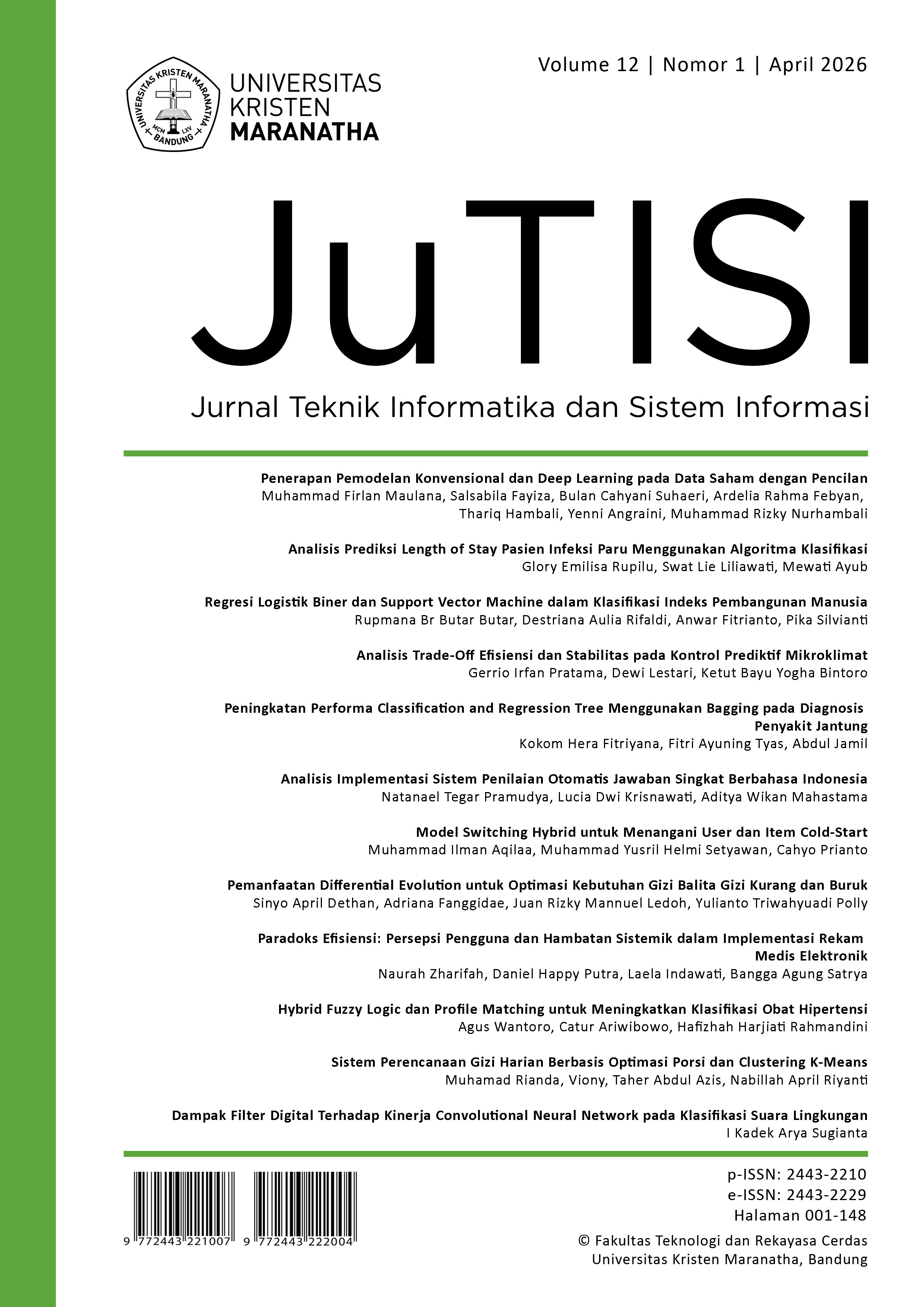
Switching Hybrid Model for Handling User and Item Cold-Start
Article Sidebar
Published:
Apr 23, 2026
Keywords:
Cold-Start, Switching Hybrid, Recommendation System Cold-Start, Hybrid Switching, Sistem Rekomendasi
Main Article Content
Abstract
Recommender systems face significant challenges under cold-start conditions, where information about users or items is still limited. This study proposes a hybrid switching approach that adaptively combines Content-Based Filtering (CBF), User-Based Collaborative Filtering (CF), and Item-Based CF based on the number of user and item interactions. The evaluation was conducted through cold-start scenario testing for a single user, accuracy measurement using RMSE and MAE with 5-Fold Cross-Validation, and adaptivity testing under varying levels of cold-start conditions (5%, 20%, and 50%). Experimental results show that the hybrid model effectively handles all cold-start scenarios by falling back to CBF or CF User-Based when data is insufficient, and opting for CF Item-Based when sufficient information is available. The model achieved the best performance with an average RMSE of 0.8165 and MAE of 0.6592, along with low standard deviations, indicating stable performance across folds. Furthermore, the hybrid system demonstrated dynamic adaptability to data completeness levels, with a gradual shift in fallback algorithm usage as cold-start severity increased. Therefore, the hybrid switching approach not only excels in accuracy but also offers flexibility and robustness, making it an effective solution for improving the quality of recommender systems in scenarios with incomplete data.
Downloads
Download data is not yet available.
Article Details
How to Cite
[1]
M. I. . Aqilaa, M. Y. H. Setyawan, and C. Prianto, “Switching Hybrid Model for Handling User and Item Cold-Start”, JuTISI, vol. 12, no. 1, pp. 74–86, Apr. 2026.
Section
Articles

This work is licensed under a Creative Commons Attribution-NonCommercial 4.0 International License.
This is an open-access article distributed under the terms of the Creative Commons Attribution-NonCommercial 4.0 International License (https://creativecommons.org/licenses/by-nc/4.0/) which permits unrestricted non-commercial used, distribution and reproduction in any medium.
This work is licensed under a Creative Commons Attribution-NonCommercial 4.0 International License.