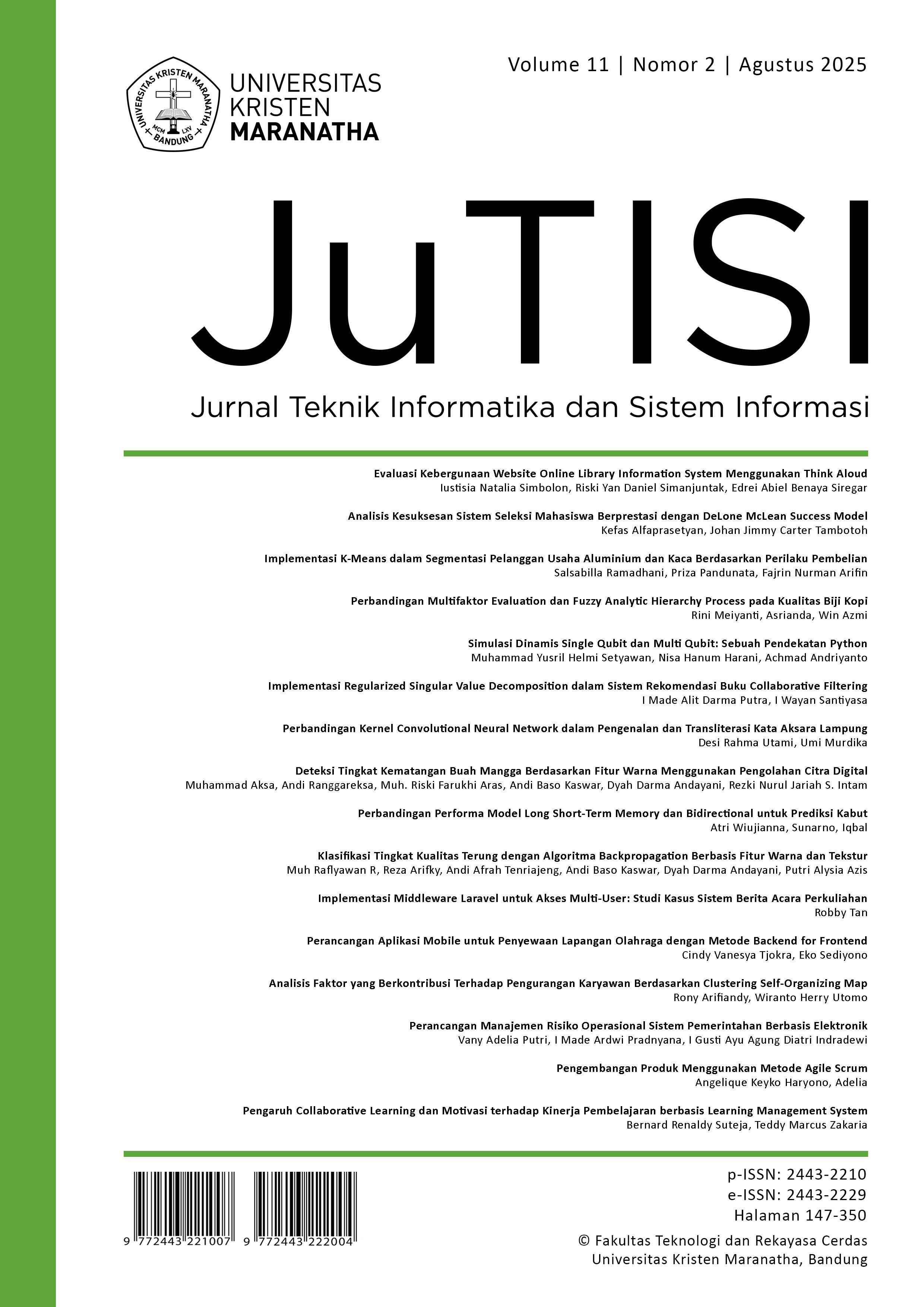
Comparison of Long Short-Term Memory and Bidirectional Models for Fog Prediction
Article Sidebar
Published:
Aug 14, 2025
Keywords:
BiLSTM, Data cuaca, Kabut , LSTM BiLSTM, Fog, LSTM, Weather data
Main Article Content
Abstract
Fog is a weather phenomenon that can significantly reduce visibility and impact transportation safety as well as public activities. The Citeko region in Bogor, located in a highland area, experiences a relatively high frequency of fog events, especially during the morning and rainy seasons. This study aims to develop and compare the performance of fog prediction models using Long Short-Term Memory (LSTM) and Bidirectional LSTM (BiLSTM) algorithms based on historical weather data from 2013 to 2023. The data, obtained from the Citeko Meteorological Station, includes weather parameters such as dry-bulb temperature, wet-bulb temperature, dew point, visibility, relative humidity, cloud cover, wind direction and speed, and hourly weather conditions. The data underwent several preprocessing steps, including missing value interpolation, fog classification based on weather parameters, normalization, and splitting into training and testing sets (80:20 ratio). The LSTM and BiLSTM models were then trained using a deep learning approach, both with and without early stopping. The results show that BiLSTM with early stopping achieved the best performance: 99.93% accuracy, 96.53% precision, 98.81% recall, and an F1-score of 97.66%, with only 9 false positives and 3 false negatives. This study contributes to the development of fog prediction systems based on artificial intelligence.
Downloads
Download data is not yet available.
Article Details
How to Cite
[1]
A. Wiujianna, S. Sunarno, and I. Iqbal, “Comparison of Long Short-Term Memory and Bidirectional Models for Fog Prediction”, JuTISI, vol. 11, no. 2, pp. 251 –, Aug. 2025.
Section
Articles

This work is licensed under a Creative Commons Attribution-NonCommercial 4.0 International License.
This is an open-access article distributed under the terms of the Creative Commons Attribution-NonCommercial 4.0 International License (https://creativecommons.org/licenses/by-nc/4.0/) which permits unrestricted non-commercial used, distribution and reproduction in any medium.
This work is licensed under a Creative Commons Attribution-NonCommercial 4.0 International License.