
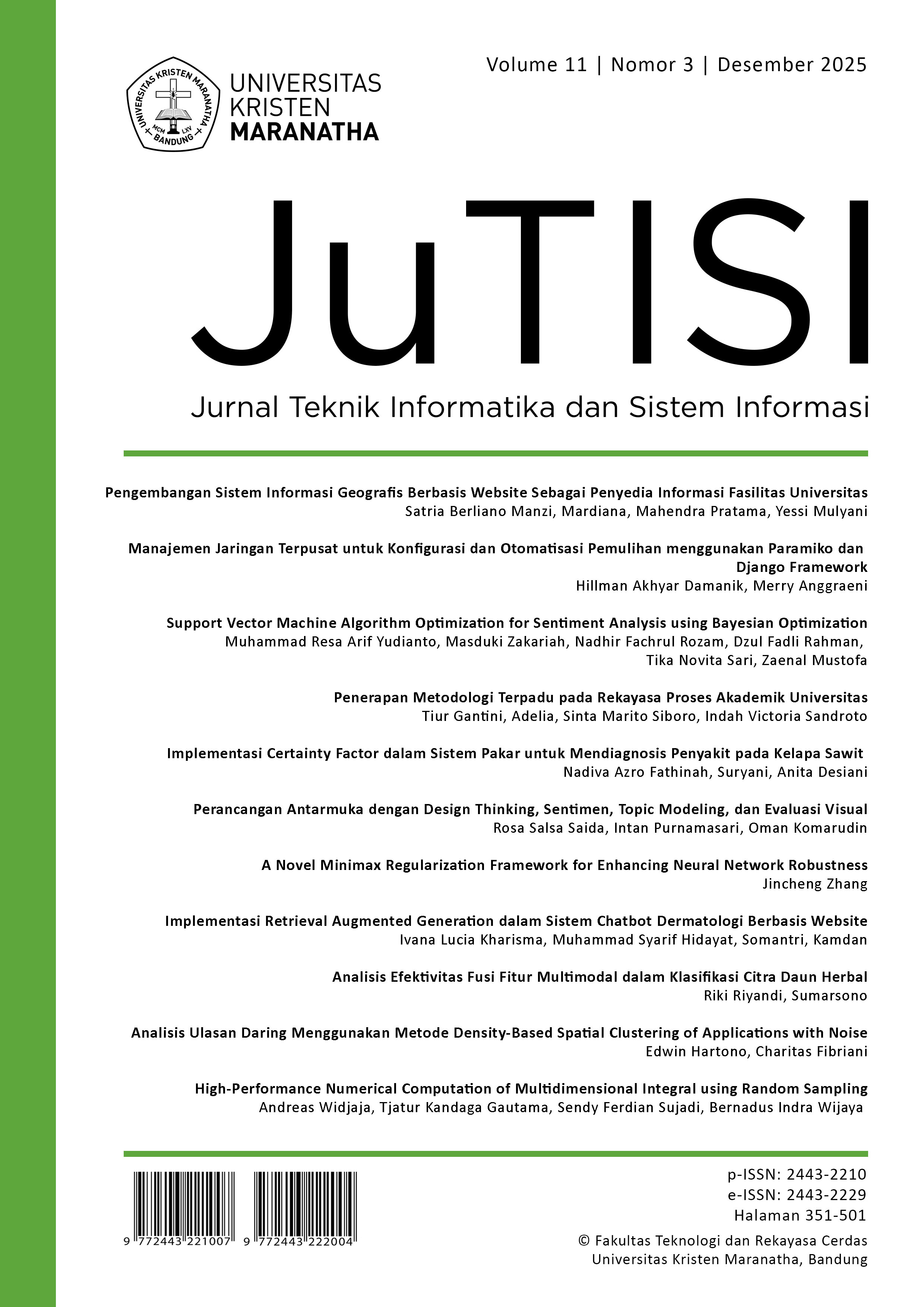
Suatu Usulan Kerangka Kerja Regularisasi Minimax untuk Meningkatkan Ketahanan Jaringan Saraf Tiruan
Bilah Samping Artikel
Diterbitkan:
Dec 15, 2025
Kata Kunci:
Generalization Enhancement, Minimax Principle, Parameter Perturbation, Regularization Framework, Robust Training Strategy Parameter Perturbasi, Peningkatan Daya Generalisasi, Prinsip Minimax, Regularisasi, Strategi Pelatihan Berketahanan
Isi Artikel Utama
Abstrak
Dalam pengembangan deep learning, teknik regularisasi telah banyak digunakan untuk meningkatkan kemampuan generalisasi dan ketahanan model. Namun, metode regularisasi tradisional seringkali didasarkan pada asumsi apriori dan gagal memperhitungkan sepenuhnya kinerja kasus terburuk model. Makalah ini mengusulkan mekanisme regularisasi berdasarkan teorema Minimax, yang memperkenalkan konsep "adversarial kasus terburuk" selama pelatihan untuk meningkatkan ketahanan model. Melalui verifikasi eksperimental pada dataset Canadian Institute for Advanced Research (CIFAR), subset berlabel 10 kelas dari dataset Tiny Images, telah berhasil diuji coba bahwa metode ini memperlihatkan performa lebih baik daripada model multi-layer perceptron (MLP) standar di berbagai matrik evaluasi dan menunjukkan kinerja generalisasi yang baik. Metode ini memiliki penerapan yang luas dan dapat diperluas ke berbagai arsitektur, termasuk jaringan saraf tiruan konvolusional, jaringan saraf tiruan graf, dan model pemrosesan bahasa alami.
Unduhan
Data unduhan belum tersedia.
Rincian Artikel
Cara Mengutip
[1]
J. Zhang, “Suatu Usulan Kerangka Kerja Regularisasi Minimax untuk Meningkatkan Ketahanan Jaringan Saraf Tiruan”, JuTISI, vol. 11, no. 3, hlm. 435–447, Des 2025.
Terbitan
Bagian
Articles

Artikel ini berlisensi Creative Commons Attribution-NonCommercial 4.0 International License.
This is an open-access article distributed under the terms of the Creative Commons Attribution-NonCommercial 4.0 International License (https://creativecommons.org/licenses/by-nc/4.0/) which permits unrestricted non-commercial used, distribution and reproduction in any medium.
This work is licensed under a Creative Commons Attribution-NonCommercial 4.0 International License.