
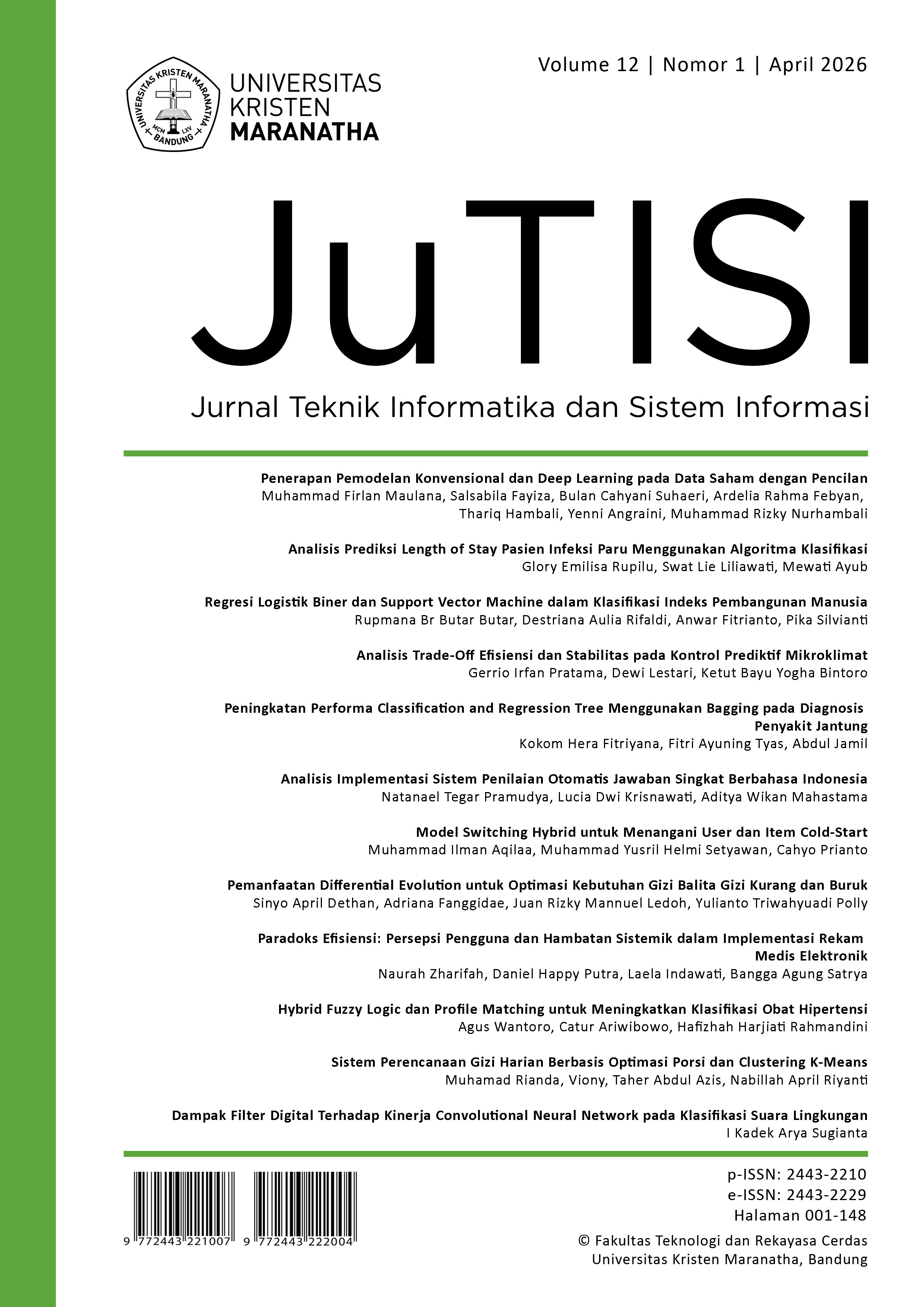
A Trade-Off Analysis of Efficiency and Stability in Predictive Microclimate Control
Article Sidebar
Published:
Apr 23, 2026
Keywords:
ARIMA, Internet of Things (IoT), Microclimate Management, Predictive Control, Trade-Off Analysis Analisis Trade-Off, ARIMA, Internet of Things (IoT), Kontrol Prediktif, Manajemen Mikroklimat
Main Article Content
Abstract
Precise microclimate control is a crucial aspect in various IoT applications, yet commonly used reactive, threshold-based control strategies often prove to be inefficient. This study presents a simulation-based comparative analysis to quantitatively evaluate the performance between a reactive control strategy and a more intelligent predictive one. Using time-series humidity data from a Tropidolaemus sp. terrarium, a SARIMA forecasting model was developed and validated to drive the predictive controller. The performance of both strategies was then benchmarked in a simulation environment based on two key metrics: actuation efficiency and environmental stability. The results demonstrate that the predictive controller is significantly more efficient, reducing actuator activations by up to 47% compared to the reactive controller. However, this study reveals a fundamental trade-off: this efficiency is accompanied by a decrease in stability due to an overshoot phenomenon caused by a rigid control action mechanism. This study concludes that the superiority of proactive prediction must be synergized with adaptive action mechanisms to achieve holistic system optimality, while also presenting a simulation methodology as an efficient framework for evaluating intelligent control systems.
Downloads
Download data is not yet available.
Article Details
How to Cite
[1]
G. I. Pratama, D. . Lestari, and K. B. Y. Bintoro, “A Trade-Off Analysis of Efficiency and Stability in Predictive Microclimate Control”, JuTISI, vol. 12, no. 1, pp. 35–44, Apr. 2026.
Section
Articles

This work is licensed under a Creative Commons Attribution-NonCommercial 4.0 International License.
This is an open-access article distributed under the terms of the Creative Commons Attribution-NonCommercial 4.0 International License (https://creativecommons.org/licenses/by-nc/4.0/) which permits unrestricted non-commercial used, distribution and reproduction in any medium.
This work is licensed under a Creative Commons Attribution-NonCommercial 4.0 International License.