
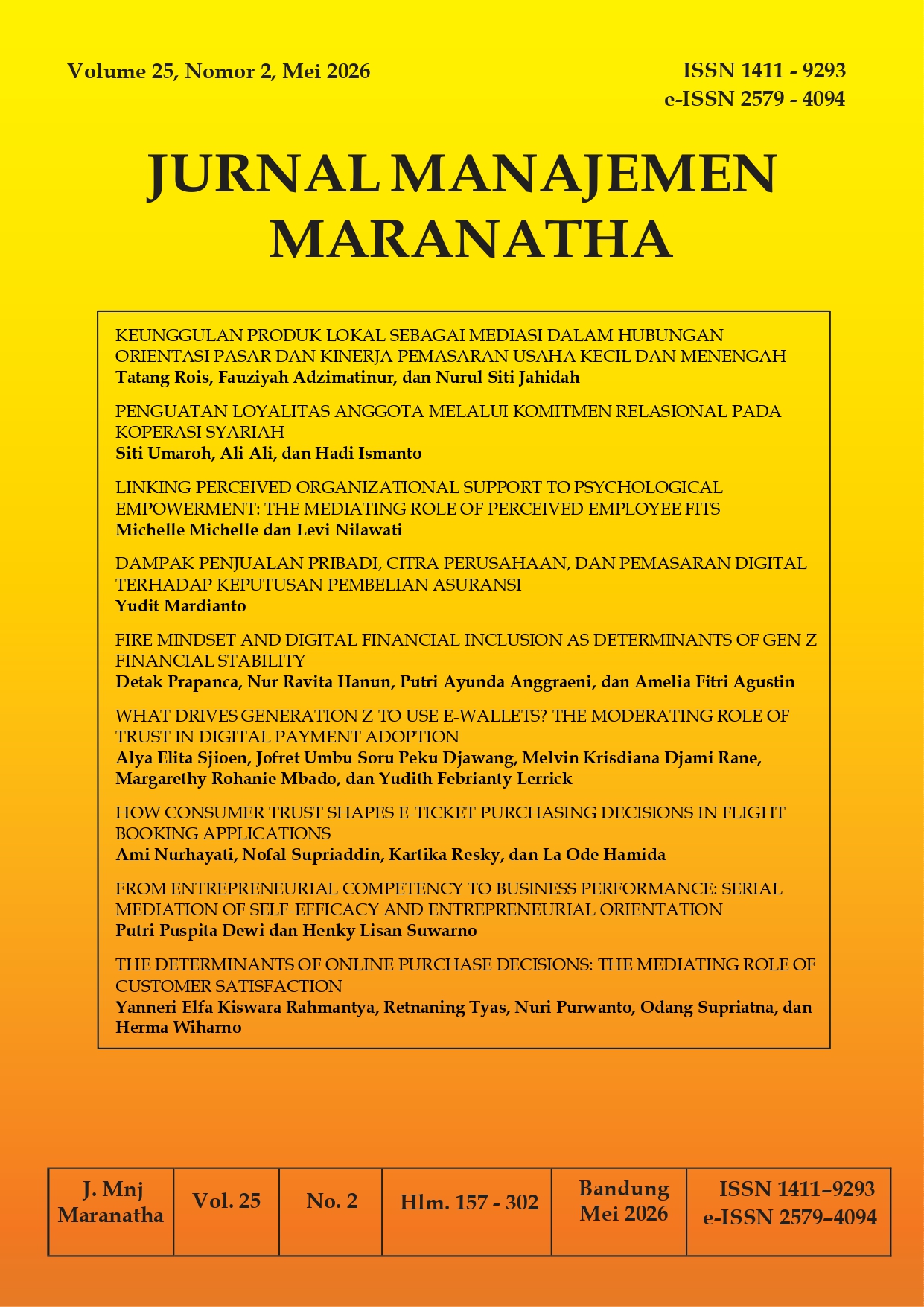
Linking perceived organizational support to psychological empowerment: The mediating role of perceived employee fits
Article Sidebar
Main Article Content
Abstract
Downloads
Article Details

This work is licensed under a Creative Commons Attribution-NonCommercial 4.0 International License.
References
Adongo, R., (Sam) Kim, S., & Elliot, S. (2019). “Give and take”: A social exchange perspective on festival stakeholder relations. Annals of Tourism Research, 75, 42-57. https://doi.org/10.1016/j.annals.2018.12.0050
Ahmed, I., Nawaz, M. M., Ali, G., & Islam, T. (2015). Perceived organizational support and its outcomes: A meta-analysis of latest available literature. Management Research Review, 38(6), 627-639. https://doi.org/10.1108/MRR-09-2013-0220
Anthonysamy, L., Tan, C. N. L., Lim, O. W., & Zainal, Z. (2025). The mediating effect of organizational prestige on extrinsic rewards and employee retention. SAGE Open, 15(2), 1-14. https://doi.org/10.1177/21582440251330006
Astuty, I., & Udin, U. (2020). The effect of perceived organizational support and transformational leadership on affective commitment and employee performance. Journal of Asian Finance, Economics and Business, 7(10), 401-411. https://doi.org/10.13106/jafeb.2020.vol7.no10.401
Baldassari, P., Eberhard, S., Jiang, Y., Muller-Camen, M., Obereder, L., Schiffinger, M., & Thiele, R. (2023). Looking up and fitting in: Team leaders’ and members’ behaviors and attitudes toward the environment in an MNC. Human Resource Management, 62(3), 267-282. https://doi.org/10.1002/hrm.22163
Briñol, P., & Petty, R. E. (2021). Self-validation theory: An integrative framework for understanding when thoughts become consequential. Psychological Review, 129(2), 340-367. https://doi.org/10.1037/rev0000340
Buheji, M., Ahmed, D., & Jahrami, H. (2020). Living uncertainty in the new normal. International Journal of Applied Psychology, 10(2), 21-31. https://doi.org/10.5923/j.ijap.20201002.01
Coun, M. J. H., Peters, P., Blomme, R. J., & Schaveling, J. (2022). ‘To empower or not to empower, that’s the question’: Using an empowerment process approach to explain employees’ workplace proactivity. International Journal of Human Resource Management, 33(14), 2829-2855. https://doi.org/10.1080/09585192.2021.1879204
Degago, E., & Aschale, Y. (2018). Role of microfinances in socio-economic and psychological empowerment of women in some selected zones of Somali Region, Ethiopia. Journal of Poverty, Investment and Development, 44, 67-81. https://www.iiste.org/Journals/index.php/JPID/article/view/42891/44185
Du, J., Shin, Y., & Choi, J. N. (2015). Convergent perceptions of organizational efficacy among team members and positive work outcomes in organizational teams. Journal of Occupational and Organizational Psychology, 88(1), 178-202. https://doi.org/10.1111/joop.12085
Eisenberger, R., Shanock, R. L., & Wen, X. (2020). Perceived organizational support: Why caring about employees counts. Annual Review of Organizational Psychology and Organizational Behavior, 7, 101-124. https://doi.org/10.1146/annurev-orgpsych-012119-044917
Ghozali, I. (2016). Aplikasi analisis multivariate. Badan Penerbit Universitas Diponegoro
Gregory, B. (2024). The antecedents and consequences of perceptual fit: An examination of how employees come to understand organizational culture. International Journal of Organizational Analysis, 32(4), 645-661. https://doi.org/10.1108/IJOA-01-2023-3573
Gu, X., Liu, C., Ma, J., & Du, C. (2024). Supervisor ostracism and employees’ emotional labor: The moderating effect of interpersonal harmony. Journal of Business and Psychology, 39(2), 455-470. https://doi.org/10.1007/s10869-023-09891-x
Hamid, M., Jam, F. A., & Mehmood, S. (2019). Psychological empowerment and employee attitudes: Mediating role of intrinsic motivation. International Journal of Business and Economic Affairs, 4(6), 300-314. https://doi.org/10.24088/ijbea-2019-46005
Hayes, A. F. (2018). Partial, conditional, and moderated moderated mediation: Quantification, inference, and interpretation. Communication Monographs, 85(1), 4-40. https://doi.org/10.1080/03637751.2017.1352100
Islam, T., Ahmed, I., & Ahmad, U. N. B. U. (2015). The influence of organizational learning culture and perceived organizational support on employees’ affective commitment and turnover intention. Nankai Business Review International, 6(4), 417-431. https://doi.org/10.1108/NBRI-01-2015-0002
Kasmir. (2018). Bank dan Lembaga Keuangan Lainnya. Rajawali Pers
Khairani, A. Z., Ismail, A., & Kadir, N. A. (2021). Assessing the factor structure of the Spreitzer’s psychological empowerment scale among Malaysian teachers. Cakrawala Pendidikan, 40(3), 564-572. https://doi.org/10.21831/cp.v40i3.41035
Kurtessis, J. N., Eisenberger, R., Ford, M. T., Buffardi, L. C., Stewart, K. A., & Adis, C. S. (2017). Perceived organizational support: A meta-analytic evaluation of organizational support theory. Journal of Management, 43(6), 1854-1884. https://doi.org/10.1177/0149206315575554