
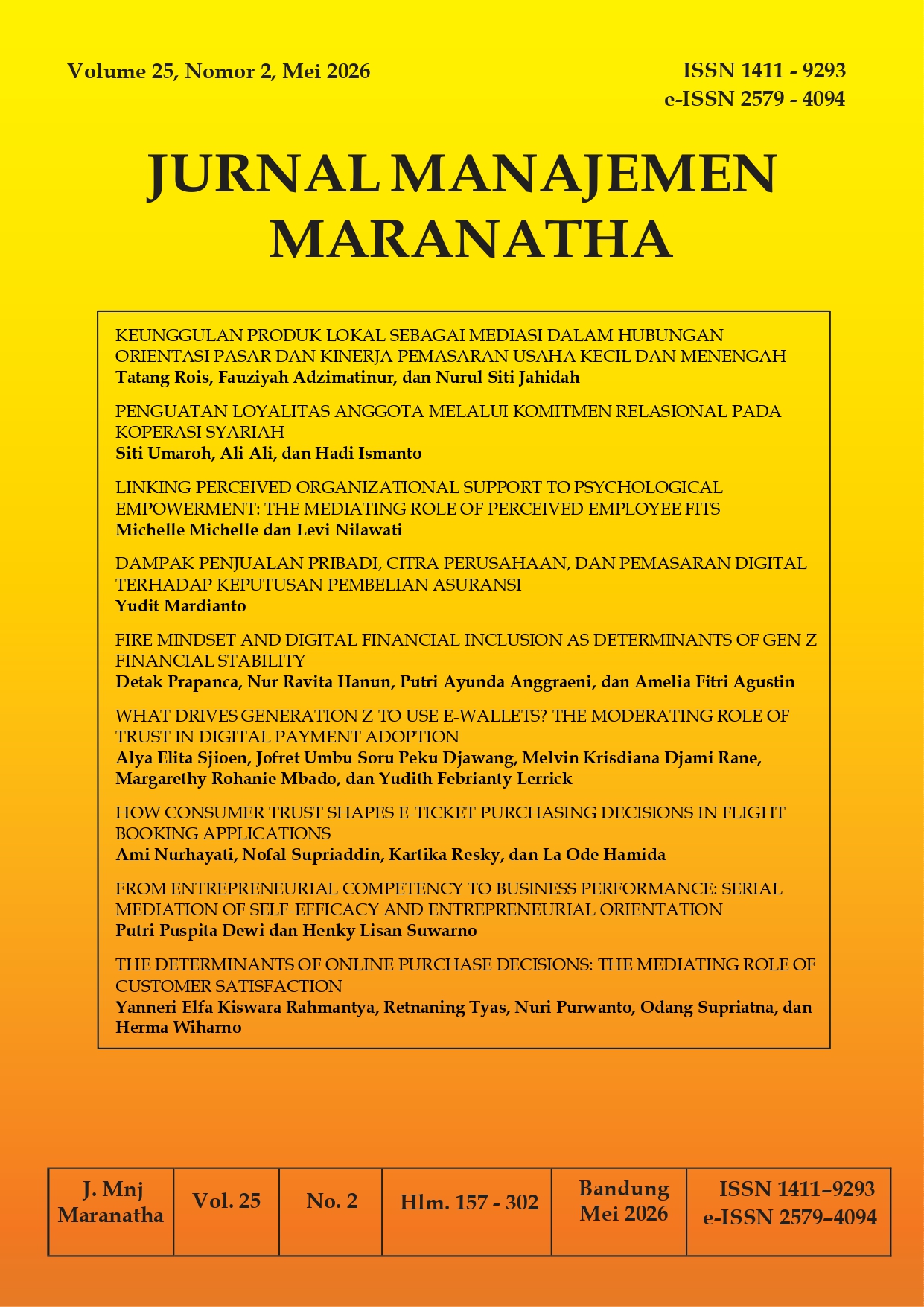
Mindset FIRE dan digital financial inclusion sebagai penentu stabilitas keuangan Generasi Z
Bilah Samping Artikel
Isi Artikel Utama
Abstrak
Unduhan
Rincian Artikel

Artikel ini berlisensi Creative Commons Attribution-NonCommercial 4.0 International License.
Referensi
Ajzen, I. (1991). The Theory of Planned Behavior. Organizational Behavior and Human Decision Processes, 50(2), 179-211. https://doi.org/10.1016/0749-5978(91)90020-T
Ali, F., Rasoolimanesh, S. M., Sarstedt, M., Ringle, C. M., & Ryu, K. (2018). An assessment of the use of partial least squares structural equation modeling (PLS-SEM) in hospitality research. International Journal of Contemporary Hospitality Management, 30(1), 514-538. https://doi.org/10.1108/IJCHM-10-2016-0568
Brüggen, E. C., Hogreve, J., Holmlund, M., Kabadayi, S., & Löfgren, M. (2017). Financial well-being: A conceptualization and research agenda. Journal of Business Research, 79, 228-237. https://doi.org/10.1016/j.jbusres.2017.03.013
Demirgüç-Kunt, A., Klapper, L., Singer, D., & Ansar, S. (2022). The global findex database 2021: Financial inclusion, digital payments, and resilience in the age of Covid-19. World Bank Group. http://documents.worldbank.org/curated/en/099818107072234182
Etikan, I. (2016). Comparison of convenience sampling and purposive sampling. American Journal of Theoretical and Applied Statistics, 5(1). https://doi.org/10.11648/j.ajtas.20160501.11
Fernandes, D., Lynch, J. G., & Netemeyer, R. G. (2014). Financial literacy, financial education, and downstream financial behaviors. Management Science, 60(8), 1861-1883. https://doi.org/10.1287/mnsc.2013.1849
Fornell, C., & Larcker, D. F. (1981). Evaluating structural equation models with unobservable variables and measurement error. Journal of Marketing Research, 18(1), 39-50. https://doi.org/10.2307/3151312
Francis, T., & Hoefel, F. (2018). The influence of Gen Z, the first generation of true digital natives, is expanding. Mckinsey.Com. https://www.mckinsey.com/industries/consumer-packaged-goods/our-insights/true-gen-generation-z-and-its-implications-for-companies
Gallego-Losada, M. J., Montero-Navarro, A., García-Abajo, E., & Gallego-Losada, R. (2023). Digital financial inclusion: Visualizing the academic literature. Research in International Business and Finance, 64. https://doi.org/10.1016/j.ribaf.2022.101862
Gomber, P., Koch, J. A., & Siering, M. (2017). Digital finance and fintech: Current research and future research directions. Journal of Business Economics, 87(5), 537-580. https://doi.org/10.1007/s11573-017-0852-x
Hair, J. F., Hult, G. T. M., Ringle, C. M., & Sarstedt, M. (2019). When to use and how to report the results of PLS-SEM. European Business Review, 31(1), 2-24. https://doi.org/10.1108/EBR-11-2018-0203
Hair, J. F., Hult, G. T. M., Ringle, C. M., & Sarstedt, M. (2022). A primer on partial least squares structural equation modeling (PLS-SEM). SAGE Publishing. https://www.researchgate.net/publication/354331182
Hasan, R., Ashfaq, M., Parveen, T., & Gunardi, A. (2023). Financial inclusion: Does digital financial literacy matter for women entrepreneurs? International Journal of Social Economics, 50(8), 1085-1104. https://doi.org/10.1108/IJSE-04-2022-0277
Hauff, J. C., Carlander, A., Gärling, T., & Nicolini, G. (2020). Retirement financial behaviour: How important is being financially literate? Journal of Consumer Policy, 43(3), 543-564. https://doi.org/10.1007/s10603-019-09444-x
Henseler, J., Hubona, G., & Ray, P. A. (2016). Using PLS path modeling in new technology research. Industrial Management and Data Systems, 116(1), 2-20. https://doi.org/10.1108/IMDS-09-2015-0382
Lusardi, A., & Mitchell, O. S. (2010). Implications for retirement well-being of financial literacy and planning. Pension Research Council WP 2010-26. https://doi.org/10.2139/ssrn.1695146
Lusardi, A., & Mitchell, O. S. (2014). The economic importance of financial literacy: Theory and evidence. Journal of Economic Literature, 52(1), 5-44. https://doi.org/10.1257/jel.52.1.5
Markus, H., & Wurf, E. (1987). The dynamic self-concept: A social psychological perspective. Annual Review of Psychology, 38(1), 299-337. https://doi.org/10.1146/annurev.ps.38.020187.001503
Marsh, H. W., & Craven, R. G. (2006). Reciprocal effects of self-concept and performance from a multidimensional perspective: Beyond seductive pleasure and unidimensional perspectives. Perspectives on Psychological Science, 1(2), 133-163. https://doi.org/10.1111/j.1745-6916.2006.00010.x
Marsh, H. W., & Martin, A. J. (2011). Academic self-concept and academic achievement: Relations and causal ordering. British Journal of Educational Psychology, 81(1), 59-77. https://doi.org/10.1348/000709910X503501
Marsh, H. W., & Shavelson, R. (1985). Self-concept: Its multifaceted, hierarchical structure. Educational Psychologist, 20(3), 107-123. https://doi.org/10.1207/s15326985ep2003_1
Morgan, P., & Pontines, V. (2014). Financial stability and financial inclusion. ADBI Working Paper 488. https://doi.org/10.2139/ssrn.2464018
Morgan, P. J., & Trinh, L. Q. (2017). Determinants and impacts of financial literacy in Cambodia and Vietnam. ADBI Working Paper 754. https://www.adb.org/sites/default/files/publication/325076/adbi-wp754.pdf
Ozili, P. K. (2018). Impact of digital finance on financial inclusion and stability. Borsa Istanbul Review, 18(4), 329-340. https://doi.org/10.1016/j.bir.2017.12.003
Podsakoff, P. M., MacKenzie, S. B., & Podsakoff, N. P. (2012). Sources of method bias in social science research and recommendations on how to control it. Annual Review of Psychology, 63, 539-569. https://doi.org/10.1146/annurev-psych-120710-100452
Preacher, K. J., & Hayes, A. F. (2008). Asymptotic and resampling strategies for assessing and comparing indirect effects in multiple mediator models. Behavior Research Methods, 40(3), 879-891. https://doi.org/10.3758/BRM.40.3.879
Sarstedt, M., Ringle, C. M., & Hair, J. F. (2021). Partial least squares structural equation modeling. Handbook of Market Research, 587-632. https://doi.org/10.1007/978-3-319-57413-4_15
Sirgy, M. J. (1982). Self-concept in consumer behavior: A critical review. Journal of Consumer Research, 9(3), 287-300. https://doi.org/10.1086/208924
Tang, N., Baker, A., & Peter, P. C. (2015). Investigating the disconnect between financial knowledge and behavior: The role of parental influence and psychological characteristics in responsible financial behaviors among young adults. Journal of Consumer Affairs, 49(2), 376-406. https://doi.org/10.1111/joca.12069
Taylor, N., & Davies, W. (2021). The financialization of anti-capitalism? The case of the ‘Financial Independence Retire Early’ community. Journal of Cultural Economy, 14(6), 694-710. https://doi.org/10.1080/17530350.2021.1891951
Wood, S. (2013). Generation Z as consumers: Trends and innovation. Journal of Consumer Behaviour, 12(6), 453-463. https://doi.org/10.1002/cb.1402
Xiao, J. J., & Porto, N. (2017). Financial education and financial satisfaction: Financial literacy, behavior, and capability as mediators. International Journal of Consumer Studies, 41(5), 545-555. https://doi.org/10.1111/ijcs.12348
Yue, P., Korkmaz, A. G., Yin, Z., & Zhou, H. (2022). The rise of digital finance: Financial inclusion or debt trap? Finance Research Letters, 47. https://doi.org/10.1016/j.frl.2021.102604
Zhao, X., Lynch, J. G., & Chen, Q. (2010). Reconsidering Baron and Kenny: Myths and truths about mediation analysis. Journal of Consumer Research, 37(2), 197-206. https://doi.org/10.1086/651257