
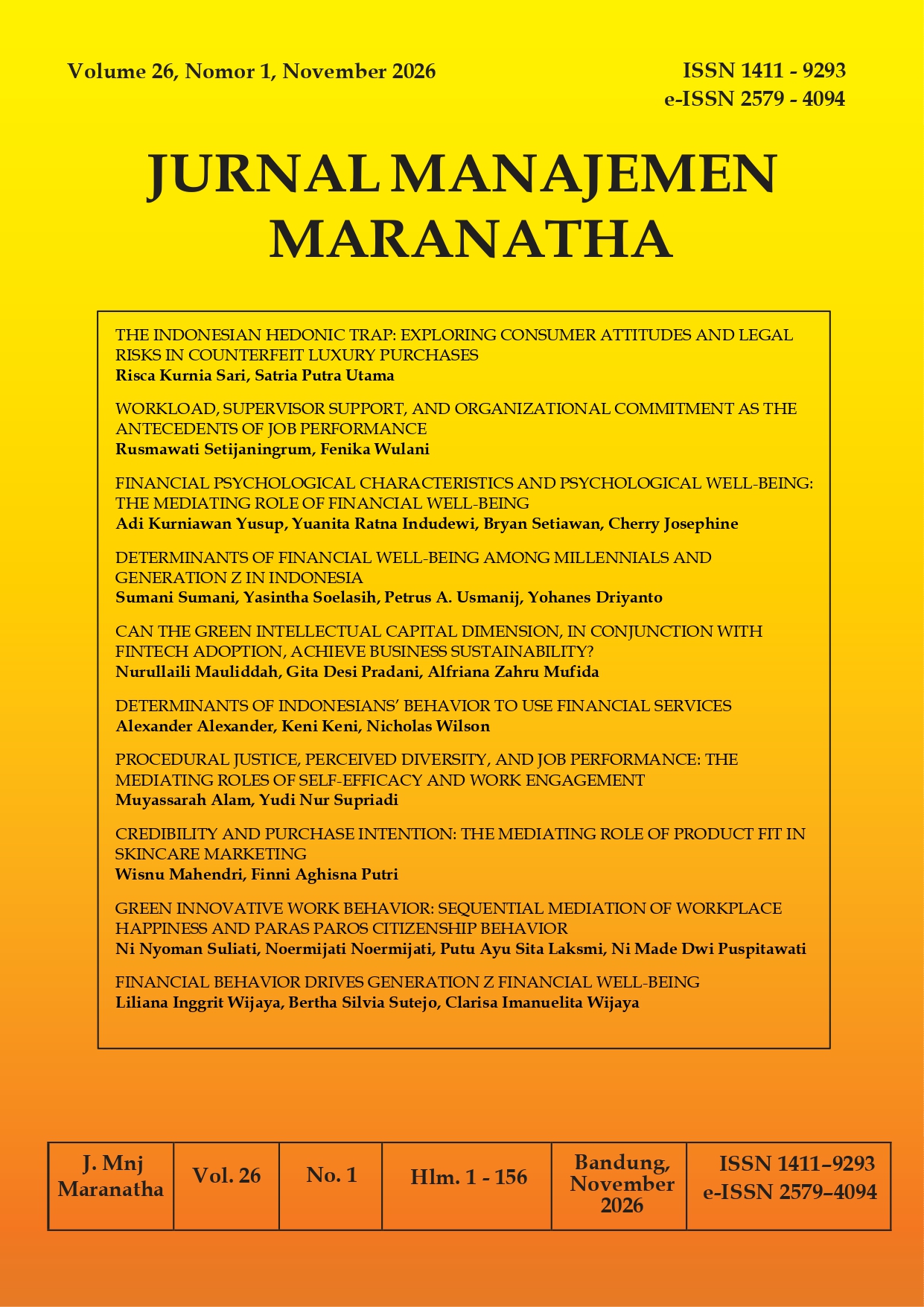
Beban kerja, dukungan penyelia, dan komitmen organisasional sebagai anteseden kinerja
Bilah Samping Artikel
Isi Artikel Utama
Abstrak
Unduhan
Rincian Artikel

Artikel ini berlisensi Creative Commons Attribution-NonCommercial 4.0 International License.
Referensi
Afzal, S., Arshad, M., & Saleem, S. (2019). The impact of perceived supervisor support on employees’ turnover intention and task performance. Journal of Management Development, 38(5), 369-382. https://doi.org/10.1108/JMD-03-2019-0076
Akram, A., Kamran, M., Iqbal, M. S., Habibah, U., & Atif Ishaq, M. (2018). The impact of supervisory justice and perceived supervisor support on organizational citizenship behavior and commitment to supervisor: The mediating role of trust. Cogent Business and Management, 5(1), 1-17. https://doi.org/10.1080/23311975.2018.1493902
Aladwan, M. A., Al Muala, I., & Salleh, H. S. (2021). Cyberloafing as a mediating variable in the relationship between workload and organizational commitment. Management Science Letters, 11, 1013-1022. https://doi.org/10.5267/j.msl.2020.9.041
Aruldoss, A., Kowalski, K. B., & Parayitam, S. (2021). The relationship between quality of work life and work-life balance mediating role of job stress, job satisfaction, and job commitment: Evidence from India. Journal of Advances in Management Research, 18(1), 36-62. https://doi.org/10.1108/JAMR-05-2020-0082
Atinga, R. A., Shembla, S., Ayawine, A., & Yambah, J. K. (2026). Workload and work stress association with midwives’ job performance in Ghana: The moderating effect of organisational support. International Journal of Africa Nursing Sciences, 24, 1-11. https://doi.org/10.1016/j.ijans.2025.100954
Balu, N., & Rathnasabapathy, M. (2025). Indirect effect of psychological capital by using partial least square (PLS) path analysis. MethodsX, 14, 1-7. https://doi.org/10.1016/j.mex.2025.103162
Bandura, A. (1991). Social cognitive theory of self-regulation. Organizational Behavior and Human Decision Processes, 50(2), 248-287. https://doi.org/10.1016/0749-5978(91)90022-L
Borg, J., Scott-Young, C. M., & Borg, N. (2023). What Generation Z needs: The role of project-based organizations in creating career sustainability. International Journal of Managing Projects in Business, 16(3), 571-591. https://doi.org/10.1108/IJMPB-12-2022-0273
Cavalinhos, S., Salgueiro, M. de F., & Marques, S. H. (2023). Mobile devices usage in retail settings: Gender and generation preferences. International Journal of Retail and Distribution Management, 51(13), 64-80. https://doi.org/10.1108/IJRDM-06-2022-0196
Choudhary, N., Naqshbandi, M. M., Philip, P. J., & Kumar, R. (2017). Employee job performance: The interplay of leaders’ emotion management ability and employee perception of job characteristics. Journal of Management Development, 36(8), 1087-1098. https://doi.org/10.1108/JMD-10-2016-0195
Chowhan, J., & Pike, K. (2025). Workload, work-life interface, stress, job satisfaction, and job performance: A job demand-resource model study during Covid-19. International Journal of Manpower, 44(4), 653-670. https://doi.org/10.1108/IJM-05-2022-0254
Donkor, F., Dongmei, Z., & Sekyere, I. (2021). The mediating effects of organizational commitment on leadership styles and employee performance in SOEs in Ghana: A structural equation modeling analysis. SAGE Open, 1-17. https://doi.org/10.1177/21582440211008894
Donohoo, J. (2026). Collective efficacy and collective flow: A calibration framework for professional learning communities. Journal of Professional Capital and Community, 1-18. https://doi.org/10.1108/JPCC-02-2026-0059
Elsaied, M. A., Elsaed, A. A., & El-maksoud, R. M. A. (2025). The effect of workload on organisational commitment among reservations employees at Egyptian hotels and travel agencies: Cyberloafing as a mediator. Journal of the Faculty of Tourism and Hotels-University of Sadat City, 9, 1-22. https://doi.org/10.21608/mfth.2025.416763
Gazi, M. A. I., Al Masud, A., Alhebri, A., Amin, M. B., Islam, M. T., Hasan, M. M., Senathirajah, A. R. bin S., & Oláh, J. (2025). The mediating role of organizational commitment and corporate social responsibility in the relationship between leadership style and job performance: An empirical study. Acta Psychologica, 260. https://doi.org/10.1016/j.actpsy.2025.105656
Gupta, B., Sihag, P., & Pangtey, R. S. (2024). If i feel valued, i am committed to change: Role of workplace dignity and perceived supervisor support. International Journal of Organizational Analysis, 32(6), 1022-1041. https://doi.org/10.1108/IJOA-10-2022-3448
Hair, J. F., Risher, J. J., Sarstedt, M., & Ringle, C. M. (2019). When to use and how to report the results of PLS-SEM. European Business Review, 31(1), 2-24. https://doi.org/10.1108/EBR-11-2018-0203
Han, B., Hiep, C., & Thi, G. (2025). Perceived supervisor support and its impact to job performance: Dataset from the hospitality industry in Vietnam. Data in Brief, 60, 1-10. https://doi.org/10.1016/j.dib.2025.111649
Imam, H., Sahi, A., & Farasat, M. (2025). The roles of supervisor support, employee engagement, and internal communication in performance: A social exchange perspective. Corporate Communications: An International Journal, 28(3), 489-505. https://doi.org/10.1108/CCIJ-08-2022-0102
Ingusci, E., Signore, F., Giancaspro, M. L., Manuti, A., Molino, M., Russo, V., Zito, M., & Cortese, C. G. (2021). Workload, techno overload, and behavioral stress during Covid-19 emergency: The role of job crafting in remote workers. Frontiers in Psychology, 12, 1-11. https://doi.org/10.3389/fpsyg.2021.655148
Jamal, M. T., Anwar, I., Khan, N. A., & Ahmad, G. (2024). How do teleworkers escape burnout? A moderated-mediation model of the job demands and turnover intention. International Journal of Manpower, 45(1), 169-199. https://doi.org/10.1108/IJM-12-2022-0628
Jin, M. H., McDonald, B., & Park, J. (2018). Does public service motivation matter in public higher education? Testing the theories of person-organization fit and organizational commitment through a serial multiple mediation model. American Review of Public Administration, 48(1), 82-97. https://doi.org/10.1177/0275074016652243
Johari, J., Tan, F. Y., & Zulkarnain, Z. I. T. (2025). Autonomy, workload, work-life balance, and job performance among teachers. International Journal for Educational Management, 32(1), 107-120. https://doi.org/10.1108/IJEM-10-2016-0226
Ma, K., & Fang, B. (2024). Exploring Generation Z’s expectations at future work: The impact of digital technology on job searching. European Journal of Training and Development, 48(9), 933-953. https://doi.org/10.1108/EJTD-05-2023-0076
Mahmoud, A. B., Fuxman, L., Mohr, I., Reisel, W. D., & Grigoriou, N. (2020). “We aren’t your reincarnation!” - Workplace motivation across X, Y and Z Generations. International Journal of Manpower, 42(1), 193-209. https://doi.org/10.1108/IJM-09-2019-0448
Memon, M. A., Ting, H., Cheah, J. -W., Thurasamy, R., Chuah, F., & Huei Cham, T. (2020). Sample size for survey research: Review and recommendations. Journal of Applied Structural Equation Modeling, 4(2), 1-20. https://doi.org/http://dx.doi.org/10.47263/JASEM.4(2)01
Msuya, M. S., & Kumar, A. B. (2022). The role of supervisor work-life support on the correlation between work autonomy, workload, and performance: Perspective from Tanzania banking employees. Future Business Journal, 8(1), 1-16. https://doi.org/10.1186/s43093-022-00139-3
Naim, M. F., & Lenka, U. (2020). Organizational learning and Gen Y employees’ affective commitment: The mediating role of competency development and moderating role of strategic leadership. Journal of Management and Organization, 26(5), 815-831. https://doi.org/10.1017/jmo.2018.19
Nasurdin, A. M., Tan, C. L., & Naseer Khan, S. (2020). Can high performance work practices and satisfaction predict job performance? An examination of the Malaysian private health-care sector. International Journal of Quality and Service Sciences, 12(4), 521-540. https://doi.org/10.1108/IJQSS-06-2019-0090
Ong, M. H. A., & Ibrahim, N. S. (2024). Creating a positive behavior intention using an online learning platform technology: The mediating role of perceived online learning enjoyment. International Journal of Information and Learning Technology, 1-18. https://doi.org/10.1108/IJILT-07-2023-0118
Pachler, D., Kuonath, A., & Frey, D. (2019). How transformational lecturers promote students’ engagement, creativity, and task performance: The mediating role of trust in lecturer and self-efficacy. Learning and Individual Differences, 69, 162-172. https://doi.org/10.1016/j.lindif.2018.12.004
Park, S., Kang, H. S. (Theresa), & Kim, E. J. (2018). The role of supervisor support on employees’ training and job performance: An empirical study. European Journal of Training and Development, 42(1-2), 57-74. https://doi.org/10.1108/EJTD-06-2017-0054
Porter, L. W., Steers, R. M., & Mowday, R. T. (1974). Organizational commitment, job satisfaction, and turnover among psychiatric technicians. Journal of Applied Psychology, 59(5), 603-609. https://doi.org/https://psycnet.apa.org/doi/10.1037/h0037335
Pourteimour, S., Yaghmaei, S., & Babamohamadi, H. (2021). The relationship between mental workload and job performance among Iranian nurses providing care to Covid-19 patients: A cross-sectional study. Journal of Nursing Management, 29, 1723-1732. https://doi.org/10.1111/jonm.13305
Qamar, F., Soomro, S., & Syed, O. R. (2023). Determining factors to foster educators’ pedagogical resilience: Test of servant leadership and social cognitive theories in post-pandemic era. Journal of Economic and Administrative Sciences, 41(4), 1548-1570. https://doi.org/10.1108/jeas-11-2022-0249
Rhoades, L., Eisenberger, R., & Armeli, S. (2001). Affective commitment to the organization: The contribution of perceived organizational support. Journal of Applied Psychology, 86(5), 825-836. https://doi.org/10.1037/0021-9010.86.5.825
Rousseau, V., & Aubé, C. (2010). Social support at work and affective commitment to the organization: The moderating effect of job resource adequacy and ambient conditions. Journal of Social Psychology, 150(4), 321-340. https://doi.org/10.1080/00224540903365380
Siswanto, S., Supriyanto, A. A., Ni’mah, U., Asnawi, N., & Wekke, I. S. (2019). Does a workload influence the performance of bank employees? Management Science Letters, 9, 639-650. https://doi.org/10.5267/j.msl.2019.2.007
Williams, L. J., & Anderson, S. E. (1991). Job satisfaction and organizational commitment as predictors of organizational citizenship and in-role behaviors. Journal of Management, 17(3), 601-617. https://doi.org/10.1177/014920639101700305
Wulani, F., Lestari, T., Smith, S., Lie, A., & Tjandra, N. (2025). The role of motivation and parental encouragement in promoting students’ career interest in STEM. Journal for STEM Education Research. https://doi.org/https://doi.org/10.1007/s41979-025-00177-w
Wulani, F., Lindawati, T., & Iswanto, Y. B. B. (2022). Work stress of online motorcycle taxi drivers: The role of coworker support, autonomy, and affective occupational commitment. Jurnal Organisasi Dan Manajemen, 18(2), 26-42. https://doi.org/10.33830/jom.v18i2.3409.2022
Yang, D., & Rosli, R. (2025). CSR dimensions and their impact on employee performance: The mediating role of organisational commitment in Beijing’s universities. International Journal of Law and Management, 1-16. https://doi.org/10.1108/ijlma-06-2024-0198
Yang, W., Hao, Q., & Song, H. (2020). Linking supervisor support to innovation implementation behavior via commitment: The moderating role of coworker support. Journal of Managerial Psychology, 35(3), 129-141. https://doi.org/10.1108/JMP-04-2018-0171
Yasin, R., Jan, G., Huseynova, A., & Atif, M. (2023). Inclusive leadership and turnover intention: The role of follower-leader goal congruence and organizational commitment. Management Decision, 61(3), 589-609. https://doi.org/10.1108/MD-07-2021-0925
Zaher, A., Prikshat, V., Vinot, D., Malik, A., & El Aziz, J. A. (2026). Physician role transformation in AI-driven healthcare: Role demands, adverse work outcomes, and AI competencies as resources. Technological Forecasting and Social Change, 227. https://doi.org/10.1016/j.techfore.2026.124645
Zeb, A., Bin Othayman, M., Goh, G. G. G., & Shah, S. A. A. (2025). Exploring the mediating role of psychological factors in the relationship between supervisor support and job performance. Journal of Modelling in Management, 20(1), 163-181. https://doi.org/10.1108/JM2-07-2023-0137
Zeb, A., Guan, G., & Goh, G. (2025). The interplay between supervisor support and job performance: Implications of social exchange and social learning theories. Journal of Applied Research in Higher Education, 15(2), 429-448. https://doi.org/10.1108/JARHE-04-2021-0143