
Determinan dari perilaku masyarakat Indonesia dalam menggunakan layanan pembiayaan
Bilah Samping Artikel
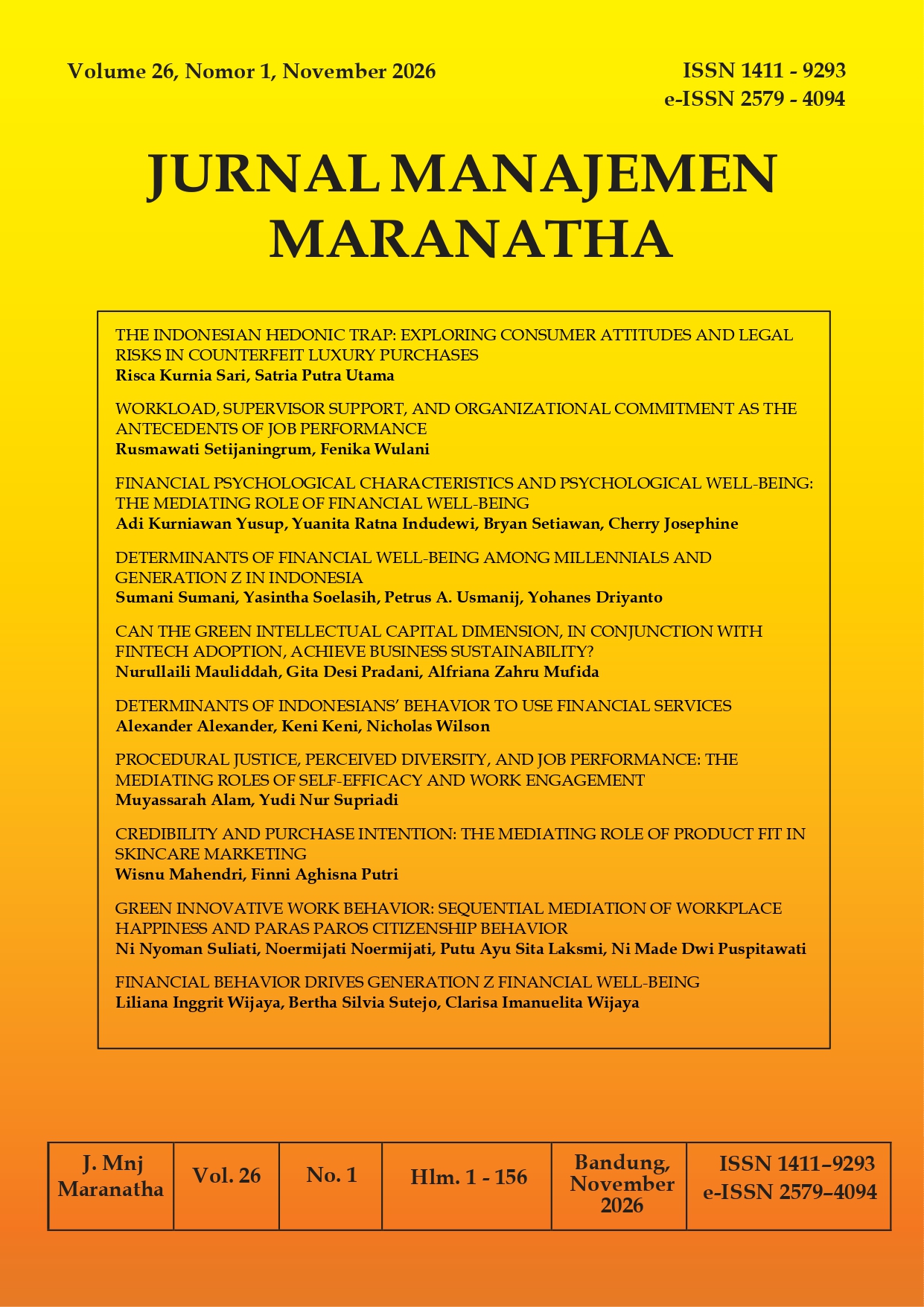
Isi Artikel Utama
Abstrak
Unduhan
Rincian Artikel

Artikel ini berlisensi Creative Commons Attribution-NonCommercial 4.0 International License.
Referensi
ACC One. (2026). Leasing mobil apa saja? Ini 4 opsi pembiayaan mobil yang aman. https://www.acc.co.id/info-terkini/leasing-mobil-apa-saja
Aguirre, C., Palazon, M., Ruiz-de-Maya, S., & Orejuela, A. R. (2026). Who should communicate CSR activities to consumers? NGO partnership and company CSR reputation as determinants. Social Responsibility Journal, 22(5), 1039-1059. https://doi.org/10.1108/srj-11-2024-0839
Ajzen, I. (1985). From intentions to actions: A theory of planned behavior. In action control: from cognition to behavior (pp. 11-39). Springer-Verlag. https://link.springer.com/chapter/10.1007/978-3-642-69746-3_2#citeas
Alshaketheep, K., Al-Ahmed, H., & Kinana, S. B. (2026). Digital marketing and the behavioral intention to use learning management systems. Acta Psychologica, 266. https://doi.org/10.1016/j.actpsy.2026.106968
Aminnuddin, N. A., & Amin, A. (2026). Theory of planned behavior versus Islamic financial literacy: Predicting Shari’ah-compliant banking adoption among Malay Muslims in Malaysia. Acta Psychologica, 264. https://doi.org/10.1016/j.actpsy.2026.106558
Arianpoor, A., & Movahed, F. R. (2026). The impact of managerial narcissism and managerial overconfidence on corporate reputation: The moderating role of managerial myopia. Journal of Asia Business Studies, 20(3), 754-774. https://doi.org/10.1108/jabs-09-2025-0601
Asdar, A., Baba, S., & Jamil, M. H. (2026). Understanding farmer adoption of the system of rice intensification (SRI) through the theory of planned behavior and its socio-economic benefits. Sustainable Futures, 11. https://doi.org/10.1016/j.sftr.2026.101801
Azhari, B. E., Lotfi, H., Issi, A. E., Hamidi, N. E., & Zaafrani, H. (2026). The impact of integrative literacy programs on rural people’s intention to engage in income-generating activities: An analysis of motivational factors in light of the theory of planned behavior. Social Sciences & Humanities Open, 13. https://doi.org/10.1016/j.ssaho.2025.102253
Barbosa, L. B. B., Cárdenas, G. M. C., Salcido, L. F. E., Palacio, R. R., & Ganga-Contreras, F. (2025). Corporate social responsibility and its influence on corporate reputation: Evidence from the industrial sector. Social Responsibility Journal, 21(8), 1566-1584. https://doi.org/10.1108/srj-06-2024-0402
Basrowi, R. W., Darus, F., Sitorus, N. L., Sundjaya, T., & Zulfiqqar, A. (2026). Analysis of mother’s intention toward iron-deficiency anemia prevention behaviour based on the theory of planned behavior. Current Women’s Health Reviews, 22(3), 29-36. https://doi.org/10.2174/0115734048361535250526075326
Bibi, G., Hashmi, H. B. A., Nauman, S., Abbass, K., & Song, H. (2025). Perspective of the theory of planned behavior and self-determination theory on sustainable hospitality: How green human resource management influences pro-environmental behavior via employee perceptions and motivation. Journal of Environmental Management, 396. https://doi.org/10.1016/j.jenvman.2025.127889
Cai, C., Zhou, L., & Liu, D. (2025). Dynamic relationship between tax reputation, digital transformation, and corporate tax compliance in financial markets. International Review of Financial Analysis, 104. https://doi.org/10.1016/j.irfa.2025.104258
Cai, H. H., Abbass, K., Lu, Q., & Shi, V. (2024). Probing the CSR-pro-environmental behavior linkage: Insights into green reputation and chief sustainability officer influence. Journal of Environmental Management, 369. https://doi.org/10.1016/j.jenvman.2024.122300
Cai, J., Ding, Y., & Jian, S. (2026). Optimizing for green skies: How do herd effects and customer heterogeneity impact airline optimal pricing and reputation investment? Transportation Research Part B: Methodological, 205. https://doi.org/10.1016/j.trb.2026.103401
Cai, S., van Berlo, Z. M. C., & Nguyen, M. H. (2026). The effectiveness of health belief model in predicting intentions for environmentally sustainable behavior: A meta-analysis. Journal of Environmental Psychology, 111. https://doi.org/10.1016/j.jenvp.2026.103019
Campian, V., & Iancu, I. (2025). Exploring sustainable fashion intentions through reverse socialization: An extension of the theory of planned behavior. Journal of Fashion Marketing and Management: An International Journal, 30(3), 483-507. https://doi.org/10.1108/jfmm-01-2025-0005
Cao, Y., Gao, Z., Myers, L. A., & Omer, T. C. (2024). Does company reputation matter for voluntary disclosure quality? Evidence from management earnings forecasts. Journal of Accounting and Public Policy, 48. https://doi.org/10.1016/j.jaccpubpol.2024.107259
Carvalho, T., & El-Geneidy, A. (2026). Do intentions translate into use? Transit market evolution and intention-behavior gaps after a new BRT service in Montreal, Canada. Transportation Research Part A: Policy and Practice, 208. https://doi.org/10.1016/j.tra.2026.104983
Chapman, B. L., Ross, A. S., & Petraki, E. (2026). Teacher readiness for generative AI: A theory of planned behaviour approach. Social Sciences & Humanities Open, 13. https://doi.org/10.1016/j.ssaho.2025.102351
Chelang’a, N. C., Mathenge, M., Okello, D. O., & Sassi, M. (2026). Influence of smallholder farmers’ entrepreneurial orientation on intention to continue using climate-smart dairy strategies: Mediating role of theory of planned behaviour constructs. Cleaner Waste Systems, 13. https://doi.org/10.1016/j.clwas.2026.100479
Chen, C., & Wei, J. (2024). Corporate violations, reputation, trade credit financing and provision: Evidence from an emerging market. International Journal of Emerging Markets, 20(12), 5097-5119. https://doi.org/10.1108/ijoem-03-2024-0397
Chen, Y. -C., & Hou, Y. -Y. (2026). Integrating design aesthetics into the theory of planned behavior: A study on electric vehicle purchase intention in China. Research in Transportation Business & Management, 67. https://doi.org/10.1016/j.rtbm.2026.101682
Daouk-Öyry, L., Alameddine, M., Rafii, B., & Soueidan, H. (2026). What shapes employees’ acceptance of and engagement with mystery patient programs for service quality improvement? A qualitative application of the theory of planned behavior. SSM - Qualitative Research in Health, 9. https://doi.org/10.1016/j.ssmqr.2026.100716
Deacon, B., Gao, X., Wang, L., Hu, X., & Takai, J. (2026). Investigating Japanese university students’ intercultural behavioral intent: A longitudinal study using the theory of planned behavior. International Journal of Intercultural Relations, 110. https://doi.org/10.1016/j.ijintrel.2025.102323
Deniz, E. (2026). Factors determining the career continuation intentions of vocational education and training students: A theory of planned behavior approach. Education + Training, 68(2), 205-237. https://doi.org/10.1108/et-08-2024-0388
Dhibi, M., & Alhajyaseen, W. (2026). Risky driving habits among Tunisia’s informal transport drivers: What can the theory of planned behavior tell us? African Transport Studies, 4. https://doi.org/10.1016/j.aftran.2026.100080
Ebbers, S., Jansen, J., & Stol, W. P. (2026). Predictors of employees’ cyber incident reporting intention: A vignette study on TPB, psychological safety, and organisational citizenship behaviour. Computers & Security, 167. https://doi.org/10.1016/j.cose.2026.104920
Etongo, D., Labrosse, J. -C., Serret, L., & Sinon, S. (2026). Using the theory of planned behavior to assess Seychellois farmers’ intentions to adopt agroforestry. Land Use Policy, 164. https://doi.org/10.1016/j.landusepol.2026.107943
Ferreira, J., Fernandes, C., & Veiga, P. M. (2025). Explainable artificial intelligence for predicting entrepreneurial intentions: A theory of planned behavior approach. International Journal of Entrepreneurial Behavior & Research, 32(4), 884-910. https://doi.org/10.1108/ijebr-05-2025-0660
Fu, Y., Wang, S., Wang, S., Chen, S., & Jiang, B. (2025). The green fog: The negative fallout of greenwashing on corporate reputation. Social Responsibility Journal, 21(10), 2217-2232. https://doi.org/10.1108/srj-02-2025-0128
Glew, R. J., Djurdjevic, E., & Xiao, J. J. (2025). Applying the theory of planned behavior in estate planning. International Journal of Bank Marketing, 44(4), 638-653. https://doi.org/10.1108/ijbm-05-2025-0376
Gomm, S., Blumer, Y., Czellar, S., Haasova, S., Kühne, S. J., Schubert, R., & Bernauer, T. (2026). Comparing and combining theory of planned behavior and dragons of inaction to explain pro-environmental consumption behavior. Sustainable Production and Consumption, 66, 1-17. https://doi.org/10.1016/j.spc.2026.04.008
Gong, Y., Guo, Y. -P., Zhang, T., Zhu, X., & Wang, L. (2026). The influence of hotel service robots on customers’ consumption intention: Combination theory of planned behaviour and technology acceptance model. Acta Psychologica, 262. https://doi.org/10.1016/j.actpsy.2025.106121
Gupta, V., Gonzales, H. B., Hungwe, D., Jaldhari, R., Xu, H., Setyawan, M. I. B., Wang, B., Yang, P., & Takahashi, F. (2026). Behavioural insights into sewage sludge hydrochar acceptance through the theory of planned behaviour and cross table analysis in Jaipur City, India. Sustainable Futures, 11. https://doi.org/10.1016/j.sftr.2026.101684
Hagger, M. S. (2026). How do traits and dispositional constructs relate to intentions and behavior? The trait-informed attitude, cognition, and intention tenet (TACIT). Social Science & Medicine, 400. https://doi.org/10.1016/j.socscimed.2026.119264
Hair, J. F., Hult, G. T. M., Ringle, C. M., & Sarstedt, M. (2022). A primer on partial least squares structural equation modeling (PLS-SEM) (3rd ed.). Sage. https://us2.sagepub.com/en-us/nam/a-primer-on-partial-least-squares-structural-equation-modeling-pls-sem/book270548
Ho-Mai, N. T., Tran, P. K. T., Tran, V. T., Tran, T. T. H., Le, H. V., & Tran, T. N. (2025). What drives residents’ support for sustainable tourism development? An integration of the push-pull-mooring model and theory of planned behavior. Journal of Hospitality and Tourism Insights, 9(5), 1881-1907. https://doi.org/10.1108/jhti-07-2025-0781
Höök, A. P., & Klöckner, C. (2026). The intention-behavior gap in electricity consumption: A longitudinal study. Energy Research & Social Science, 135. https://doi.org/10.1016/j.erss.2026.104661
Hopkins, C. D., Gabler, C. B., Richey, R. G., & Padgett, D. (2026). When reputational power shapes commitment: Industry reputation, supplier adaptation and product quality. International Journal of Physical Distribution & Logistics Management, 56(11), 155-186. https://doi.org/10.1108/ijpdlm-01-2025-0043
Hosseinlou, M. H., & Gholizadeh, A. (2026). Understanding aggressive driving: A dual-theory approach using the norm activation model and the theory of planned behavior. Transportation Letters, 18(5), 995-1007. https://doi.org/10.1080/19427867.2026.2613146
Iglesias-Sánchez, P. P., Santos-Jaén, J. M., Jambrino-Maldonado, C., & Heras-Pedrosa, C. D. L. (2026). The role of emotions in entrepreneurship and employability: A different approach of the theory of planned behaviour through neuroentrepreneuship. European Research on Management and Business Economics, 32(2). https://doi.org/10.1016/j.iedeen.2026.100316
Kajuna, J., Kansheba, J. M., & Abdallah, J. T. (2026). From intention to behavior: The moderating role of IT infrastructure on crowdfunding dynamics. Electronic Commerce Research and Applications, 77. https://doi.org/10.1016/j.elerap.2026.101596