
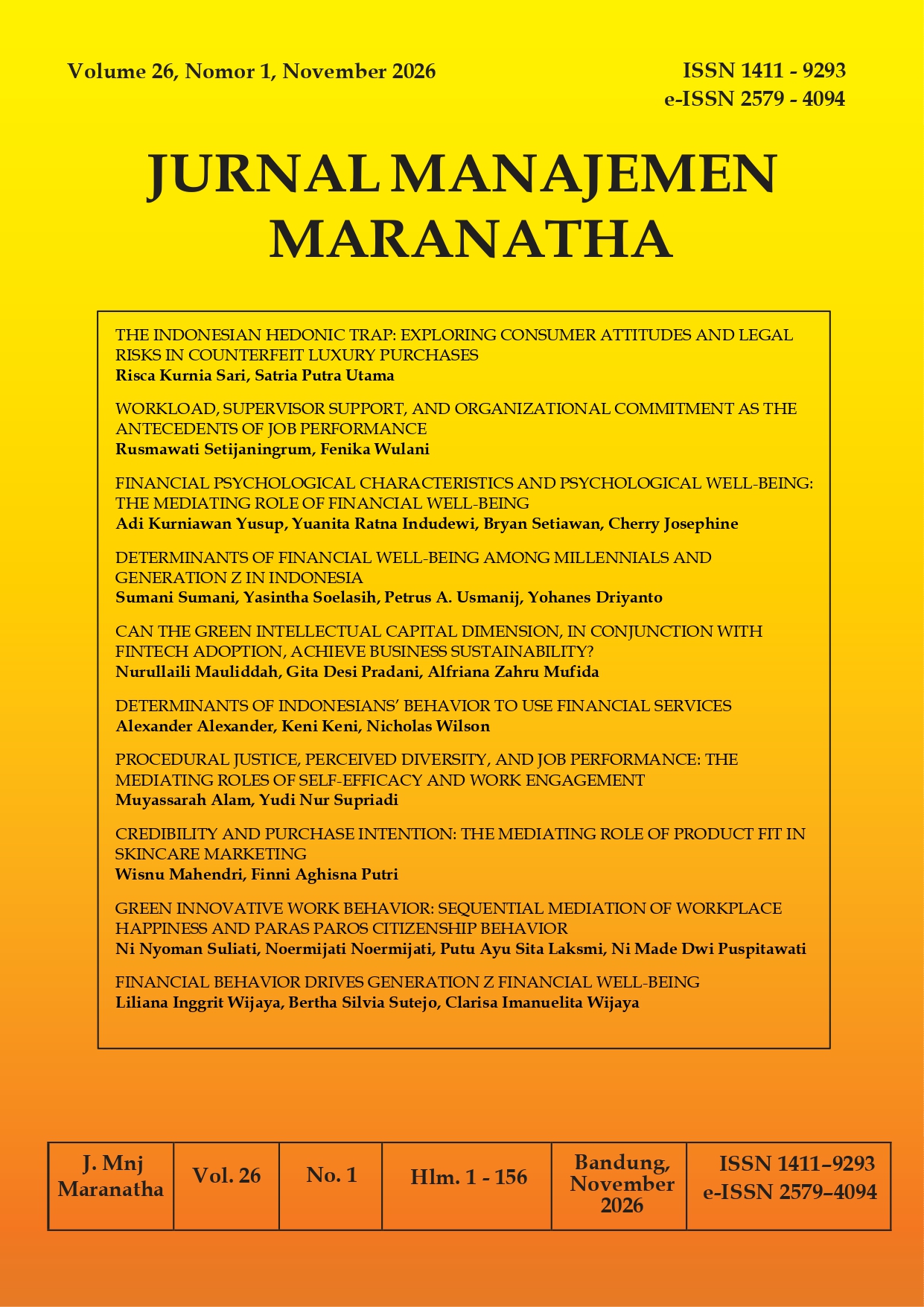
Keadilan prosedural, persepsi keberagaman, dan kinerja kerja: Peran mediasi efikasi diri dan keterikatan kerja
Bilah Samping Artikel
Isi Artikel Utama
Abstrak
Unduhan
Rincian Artikel

Artikel ini berlisensi Creative Commons Attribution-NonCommercial 4.0 International License.
Referensi
Adamovic, M., Sojo, V., Schachtman, R., & Vargas, A. (2023). Explaining the relationship between ethnicity and depressive symptoms: The roles of climate for inclusion, job self-efficacy, and job demands. Asia Pacific Journal of Management, 40(3), 903-928. https://doi.org/10.1007/s10490-022-09834-9
Badaruddin, B., Yusriadi, Y., & Fatmasari, F. (2025). Organizational dynamics of employee performance in Indonesian banking with reference to Islamic work values and workplace engagement. Discover Global Society, 3(1). https://doi.org/10.1007/s44282-025-00328-9
Bandura, A. (1986). Social foundations of thought and action. Englewood Cliffs
Bandura, A. (1999). Social cognitive theory: An agentic perspective. Asian Journal of Social Psychology, 2(1), 21-41. https://doi.org/https://doi.org/10.1111/1467-839X.00024
Bandura, A. (2012). On the functional properties of perceived self-efficacy revisited. Journal of Management, 38(1), 9-44. https://doi.org/10.1177/0149206311410606
Bougie, R., & Sekaran, U. (2019). Research methods for business: A skill building approach. John Wiley & Sons
Chen, K. -J., & Lin, C. -P. (2024). Exploring the influence of workplace environment on job performance: A socio-cognitive perspective. Total Quality Management & Business Excellence, 35(15-16), 1816-1832. https://doi.org/10.1080/14783363.2024.2404438
Coetzee, M., Veldsman, D., Potgieter, I. L., & Ferreira, N. (2025). Measuring enablers and indicators of employee engagement: Internal validity of the Flow@work engagement survey. Heliyon, 11(3). https://doi.org/https://doi.org/10.1016/j.heliyon.2025.e42386
Colquitt, J. A. (2001). On the dimensionality of organizational justice: A construct validation of a measure. Journal of Applied Psychology, 86(3), 386-400. https://doi.org/10.1037/0021-9010.86.3.386
Department of Economic and Monetary Policy. (2026). Monetary policy report - Quarter IV 2025. https://www.bi.go.id/en/publikasi/laporan/Pages/Laporan-Kebijakan-Moneter-Triwulan-IV-2025.aspx
Fida, R., Marzocchi, I., Arshad, M., Paciello, M., Barbaranelli, C., & Tramontano, C. (2025). Self-efficacy and nontask performance at work. A meta-analytic summary. Personality and Individual Differences, 241. https://doi.org/https://doi.org/10.1016/j.paid.2025.113179
Fornell, C., & Larcker, D. F. (1981). Evaluating structural equation models with unobservable variables and measurement error. Journal of Marketing Research, 18(1), 39-50. https://doi.org/10.2307/3151312
Galanakis, M. D., & Tsitouri, E. (2022). Positive psychology in the working environment. Job demands-resources theory, work engagement, and burnout: A systematic literature review. Frontiers in Psychology, 13. https://www.frontiersin.org/journals/psychology/articles/10.3389/fpsyg.2022.1022102
Hair, J., Hult, G. T. M., Ringle, C. M., & Sarstedt, M. (2021). A primer on partial least squares- structural equation modeling (PLS-SEM). Sage Publications Inc
Hasinat, I., Hjouji, Z., Loulidi, S., & Hjouji, A. (2024). The multifaceted nature of individual job performance: A focus on individual behaviors. Pakistan Journal of Life and Social Sciences, 22(2), 9554-9570. https://pjlss.edu.pk/pdf_files/2024_2/9554-9570.pdf
Hu, S., Nadeem, M. A., Thurasamy, R., Luo, J., & Yi, X. (2024). Impacts of procedural justice and ethical leadership on organizational innovation. International Journal of Asian Business and Information Management (IJABIM), 15(1), 1-26. https://doi.org/https://doi.org/10.4018/IJABIM.340775
Hung, Y. -C, Su, T. -C, & Lou, K. -R. (2022). Impact of organizational culture on individual work performance with national culture of cross-strait enterprises as a moderator. Sustainability, 14(11), https://doi.org/https://doi.org/10.3390/su14116897
Indonesia Financial Services Authority. (2025). Artificial intelligence governance for Indonesian Banks. https://ojk.go.id/en/Publikasi/Roadmap-dan-Pedoman/Perbankan/Pages/Indonesia-Artificial-Intelligence-Governance-for-Banking.aspx
Jahan, U., & Mastan, T. A. (2024). Evaluating the impact of performance management systems in enhancing task performance and contextual performance among banking employees. IOSR Journal of Business and Management, 26(5), 13-26. https://www.iosrjournals.org/iosr-jbm/papers/Vol26-issue5/Ser-7/B2605071326.pdf
Jaiswal, A., & Dyaram, L. (2019). Perceived diversity and employee well-being: Mediating role of inclusion. Personnel Review, 49(5), 1121-1139. https://doi.org/10.1108/PR-12-2018-0511
Kadomura, A., Sekiguchi, A., & Kato, T. (2025). Perceived diversity and skill diversity to utilise demographic diversity: Evidence from the factors of employee attitudes in a large Japanese company. Humanities and Social Sciences Communications, 12(1). https://doi.org/10.1057/s41599-025-05245-5
Lee, D. Y., & Jo, Y. (2023). The job demands-resource model and performance: The mediating role of employee engagement. Frontiers in Psychology, 14. https://doi.org/10.3389/fpsyg.2023.1194018
Lilly, J. D. (2022). Organizational justice. In A. Farazmand (Ed.), Global encyclopedia of public administration, public policy, and governance (pp. 8970-8976). Springer. https://doi.org/10.1007/978-3-030-66252-3_2472
Mer, A., Virdi, A. S., & Sengupta, S. (2023). Unleashing the antecedents and consequences of work engagement in NGOs through the lens of JD-R Model: Empirical evidence from India. Voluntas: International Journal of Voluntary and Nonprofit Organizations, 34(4), 721-733. https://doi.org/10.1007/s11266-022-00503-5
Meyvanali, M., Ardi, A., Berlianto, M. P., & Sunarjo, R. A. (2025). Strengthening job performance through social cognitive factors: The roles of self-efficacy, work engagement, and knowledge-oriented leadership. Social Sciences & Humanities Open, 12. https://doi.org/https://doi.org/10.1016/j.ssaho.2025.101999
Ochoa Pacheco, P., Coello-Montecel, D., & Tello, M. (2023). Psychological empowerment and job performance: Examining serial mediation effects of self-efficacy and affective commitment. Administrative Sciences, 13(3). https://doi.org/https://doi.org/10.3390/admsci13030076
Rahman, M. S. (2024). The interplay among distributive justice, procedural justice, self-efficacy, and career satisfaction: A cross-sectional study. International Journal of Business Science and Applied Management, 19(1), 30-46. https://doi.org/https://doi.org/10.69864/ijbsam.19-1.181
Shemla, M., Meyer, B., & Grgic, J. (2024). Perceived diversity in teams: Conceptualizations, effects, and new research avenues. Current Opinion in Psychology, 60. https://doi.org/https://doi.org/10.1016/j.copsyc.2024.101925
Sinniah, S., Al Mamun, A., Md Salleh, M. F., Makhbul, Z. K. M., & Hayat, N. (2022). Modeling the significance of motivation on job satisfaction and performance among the academicians: The use of hybrid structural equation modeling-artificial neural network analysis. Frontiers in Psychology, 13. https://www.frontiersin.org/journals/psychology/articles/10.3389/fpsyg.2022.935822
Sugiyono. (2023). Metode penelitian kualitatif, kuantitatif, dan R&D. Alfabeta
Vuong, B. N. (2026). The impact of generative artificial intelligence usage on job performance through job crafting and work engagement: Does digital competence matter? Computers in Human Behavior, 178. https://doi.org/https://doi.org/10.1016/j.chb.2026.108921