
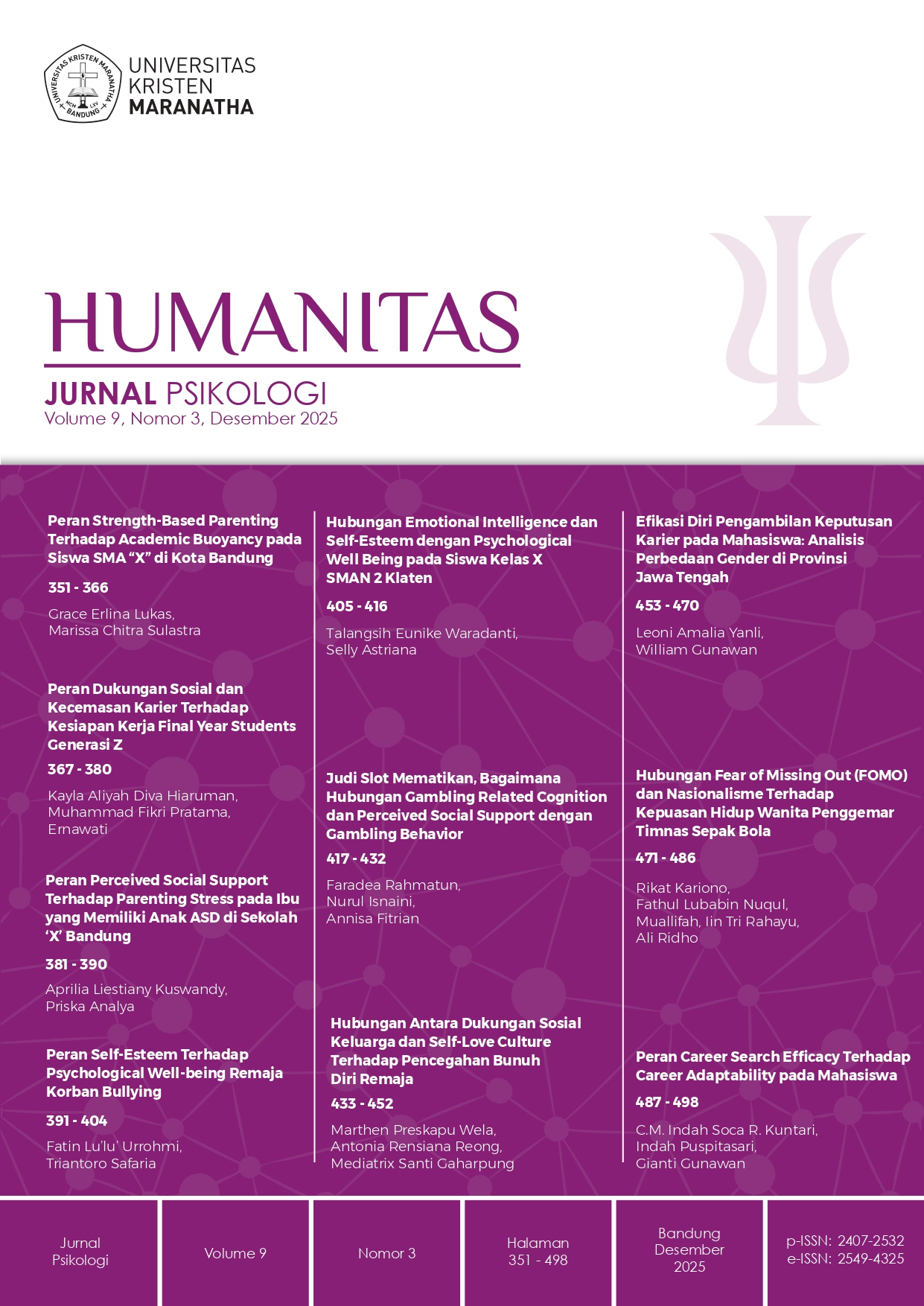
The Relationship between Fear of Missing Out (FOMO) and Nationalism on Life Satisfaction of Female National Football Team Fans
Article Sidebar
Main Article Content
Abstract
Downloads
Article Details

This work is licensed under a Creative Commons Attribution-NonCommercial 4.0 International License.
References
Along Cike, Jelpa Periantolo, B. R. (2025). Analysis of Subjective Well-Being Among Teachers at SLBN Prof . Dr . Sri Soedewi Masjchun. Crossroad Research Journal, 2(6).
Anggun Yunita Fitri, A. Y. F. (2024). The Relationship Between Father Involvement With Life Satisfaction in Adolescents in West Sumatra. In Trend : International Journal of Trends in Global Psychological Science and Education, 1(3), 52–61. https://doi.org/10.62260/intrend.v1i3.160
Aukrust, V. G. (2009). An Overview of Language and Literacy in Educational Settings. In P. Peterson, E. Baker, & B. McGaw (Eds.), International Encyclopedia of Education, Third Edition (Third Edit, pp. 345–354). Oxford: Elsevier. https://doi.org/10.1016/B978-0-08-044894-7.00506-6
Billig, M. (2003). Banal nationalism. Sage Publication, (November), 1–6.
Chidziya, K. H. (2021). “ Chele Varakashi ”: English Premiere League viewership and the resurfacing of political public sphere in Zimbabwe ‘ s Beer Halls, 5(6), 695–703.
Gujarati, J. (2013). An “inverse” relationship between mathematics identities and classroom practices among early career elementary teachers: The impact of accountability. Journal of Mathematical Behavior, 32(3), 633–648. https://doi.org/10.1016/j.jmathb.2013.08.002
Hafizh, M., Ulhaq, D., & Suratman, A. (2025). Pengaruh Work-Life Balance , Work-Family Conflict , dan Kesejahteraan Psikologis Terhadap Kinerja Karyawan Perempuan di Yogyakarta. Jurnal Ekonomi Dan Manajemen. 5, (2). https://doi.org/10.55606/optimal.v5i2.6417.
Id, J. K., Lee, Y., & Kim, M. (2020). Investigating ‘ Fear of Missing Out ’ ( FOMO ) as an extrinsic motive affecting sport event consumer ’ s behavioral intention and FOMO- driven consumption ’ s influence on intrinsic rewards , extrinsic rewards , and consumer satisfaction. PLoS ONE JOURNAL, 1–19. https://doi.org/10.1371/journal.pone.0243744
John, S., Ghosh, D., Michael, V., Kruger, D., Jain, R., Dhir, K., … Bhangu, A. (2024). Patterns and Outcomes in Pediatric Abdominal Tuberculosis: A Single Centre Cohort Study. Journal of Pediatric Surgery, 59(9), 1886–1891. https://doi.org/10.1016/j.jpedsurg.2024.04.006
Kozlowski, S. W. J. (2012). The Oxford Handbook of Organizational Psychology. Oxford University Press (Vol. 1). https://doi.org/10.1093/oxfordhb/9780199928309.001.0001
Levina Wicaksono, L. N. P. (2019). Hubungan Subjective Well-Being dengan Stres Akademik pada Mahasiswa Magister. Jurnal Ilmiah Mahasiswa Universitas Surabaya, 7(2), 1488–1498.
Lucas, R. E., Clark, A. E., Georgellis, Y., & Diener, E. (2003). Reexamining Adaptation and the Set Point Model of Happiness: Reactions to Changes in Marital Status. Journal of Personality and Social Psychology, 84(3), 527–539. https://doi.org/10.1037/0022-3514.84.3.527
McGinnis, Patrick, J. (2004). The-FOMO-Sapiens-Handbook-by-Patrick-J.-McGinnis.
Mcginnis, P. (2020). The Surprising History of the Meme that Started it All A Brief History of.
Michael Billig. (n.d.). BanalNationalismchapterb.
Przybylski, A. K., Murayama, K., Dehaan, C. R., & Gladwell, V. (2013). Motivational, emotional, and behavioral correlates of fear of missing out. Computers in Human Behavior, 29(4), 1841–1848. https://doi.org/10.1016/j.chb.2013.02.014
Putri, T. G. Y. (2023). Pengalaman dan Makna Atlet Sepak Bola Perempuan dari Perspektif Feminisa. Eprints UNY. Universitas Negeri Yogyakarta. Retrieved from http://eprints.uny.ac.id/id/eprint/78374
Raho, B. (2021). Teori sosiologi modern.
Ramadhansyah, R. (2025). Pesan visual nasionalis pada koreo garuda terhadap suporter indonesia (studi kasus indonesia vs bahrain 2025). Universitas Bina Sarana Informatika.
Rohmalina, R., Lestari, R. H., & Alam, S. K. (2019). Analisis Keterlibatan Ayah dalam Mengembangkan Perkembangan Sosial Emosional Anak Usia Dini. Golden Age: Jurnal Pendidikan Anak Usia Dini, 3(1), 1–8. https://doi.org/10.29313/ga.v3i1.4809
Ryan, R. M., & Deci, E. L. (2000). Intrinsic and Extrinsic Motivations : Classic Definitions and New Directions. Contemporary Educational Psychology 25, 54–67, 67, 54–67. https://doi.org/10.1006/ceps.1999.1020
Sianipar, N. A., & Kaloeti, D. V. S. (2019). Hubungan Antara Regulasi Diri Dengan Fear of Missing Out (FOMO) pada Mahasiswa Tahun Pertama Fakultas Psikologi Universitas Diponegoro. Jurnal EMPATI, 8(1), 136–143. https://doi.org/10.14710/empati.2019.23587
Sinaga, D. (2015). Statistik Dasar.
Sinaulan, N. L., Sengkey, M. M., Clara, S., Tarigan, B., & Sasaka, M. (2025). Hubungan Kontrol Diri dengan Fear of Missing Out ( FoMO ) pada Penggunaan Media Sosial : Sebuah Studi Literatur. Jurnal Pengabdian Masyarakat Dan Riset Pendidikan, 3(4), 5585–5590.
Skey, M., & Antonsich, M. (2017). Everyday Nationhood: Theorising culture, identity and belonging after banal Nationalism. (M. Skey, Ed.), Everyday Nationhood: Theorising Culture, Identity and Belonging After Banal Nationalism. Loughborough, UK. https://doi.org/10.1057/978-1-137-57098-7
Sousa, C., Stein, A., Shapiro, J., Shanfeld, G., Cristaudo, K., Siddiqi, M., … Reddy, H. (2023). “Life becomes about survival”: Resettlement, integration, and social services among refugee parents. Children and Youth Services Review, 155, 107191. https://doi.org/10.1016/j.childyouth.2023.107191
Zhou, S. C., Zhou, Z., Tang, Q., Yu, P., Zou, H., Liu, Q., … Luo, D. (2024). Prediction of non-suicidal self-injury in adolescents at the family level using regression methods and machine learning. Journal of Affective Disorders, 352, 67–75. https://doi.org/10.1016/j.jad.2024.02.039